1791 — 1802
Frontier Fort
The town starts as a stockade built to feed an army marching north. For its first decade it has no reason to exist except the road and the river that pass through it.
-
179130 Sept
A stockade on the east bank
General Arthur St. Clair, governor of the Northwest Territory, halts his army at a ford on the Great Miami and orders a supply post built. Completed 30 September 1791 — the date the city still counts as its founding — Fort Hamilton is the first link in a chain of outposts running north from Fort Washington at Cincinnati, provisioning the campaigns against the Native nations of the Miami, Auglaize and Maumee valleys.
St. Clair names it for the sitting Secretary of the Treasury, Alexander Hamilton. Within weeks of leaving it, St. Clair's army is destroyed on the Wabash in the worst defeat the United States Army would ever suffer against Native forces.
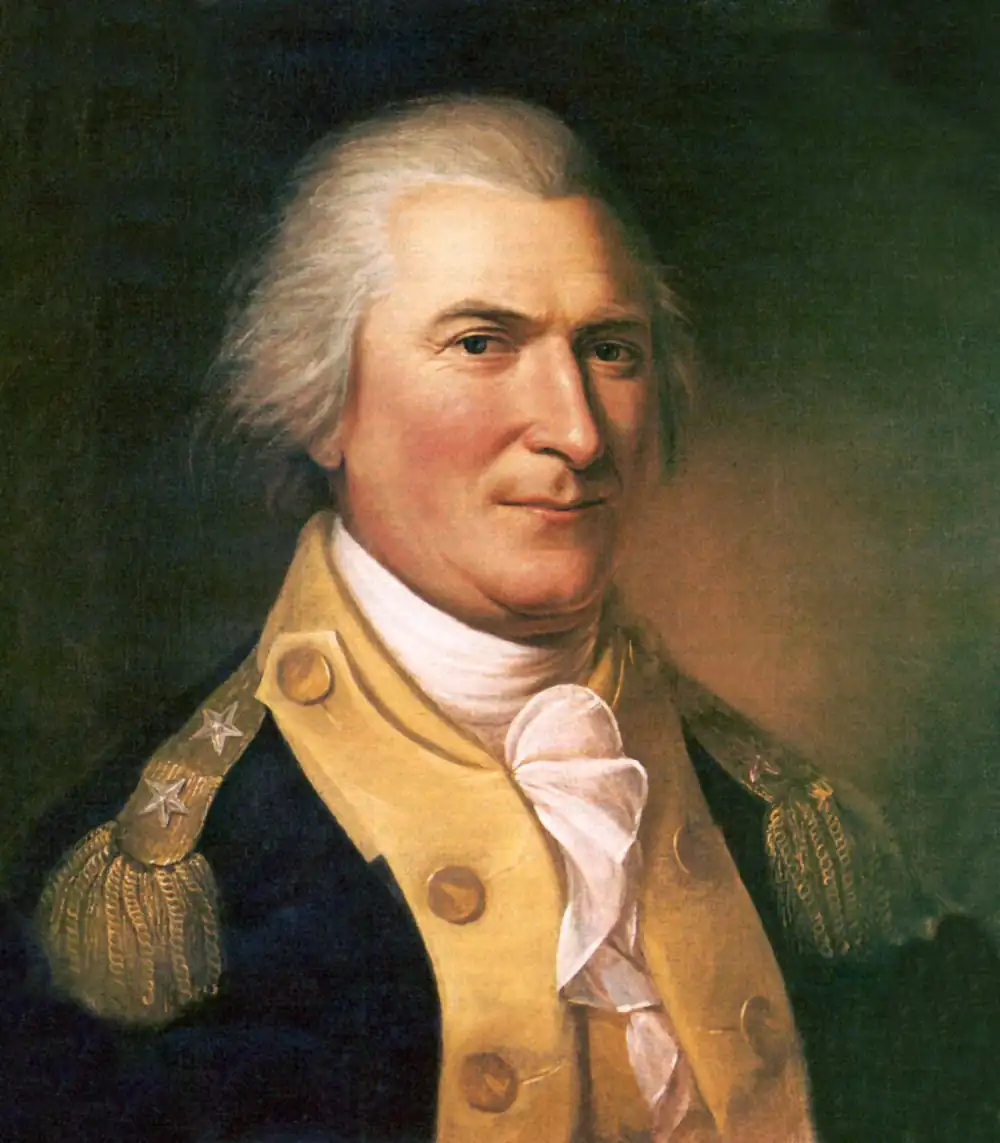
Arthur St. Clair, who ordered the fort built — painted by Charles Willson Peale.Charles Willson Peale · Public domain 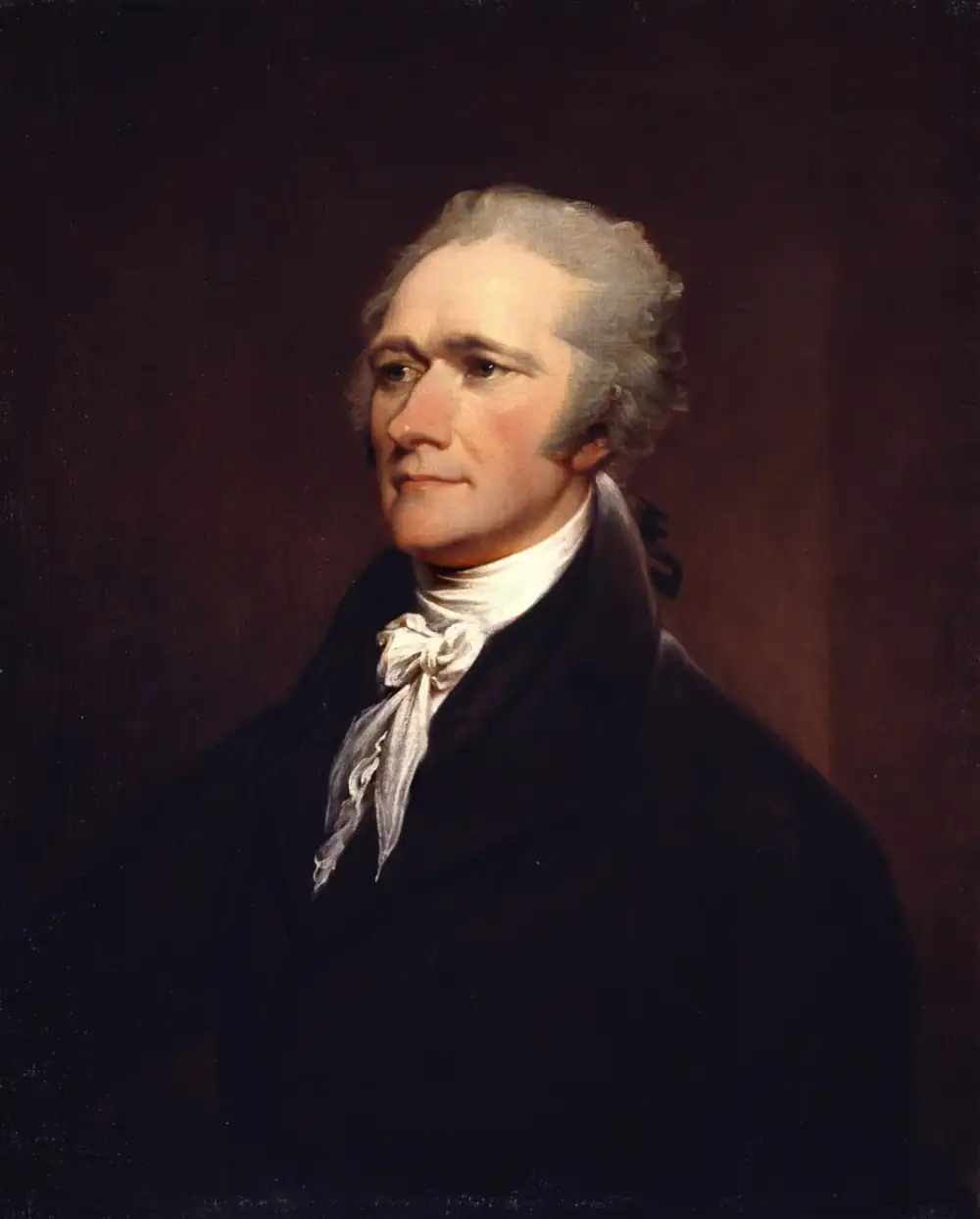
The namesake: Alexander Hamilton, by John Trumbull. He never saw the place.John Trumbull · Public domain 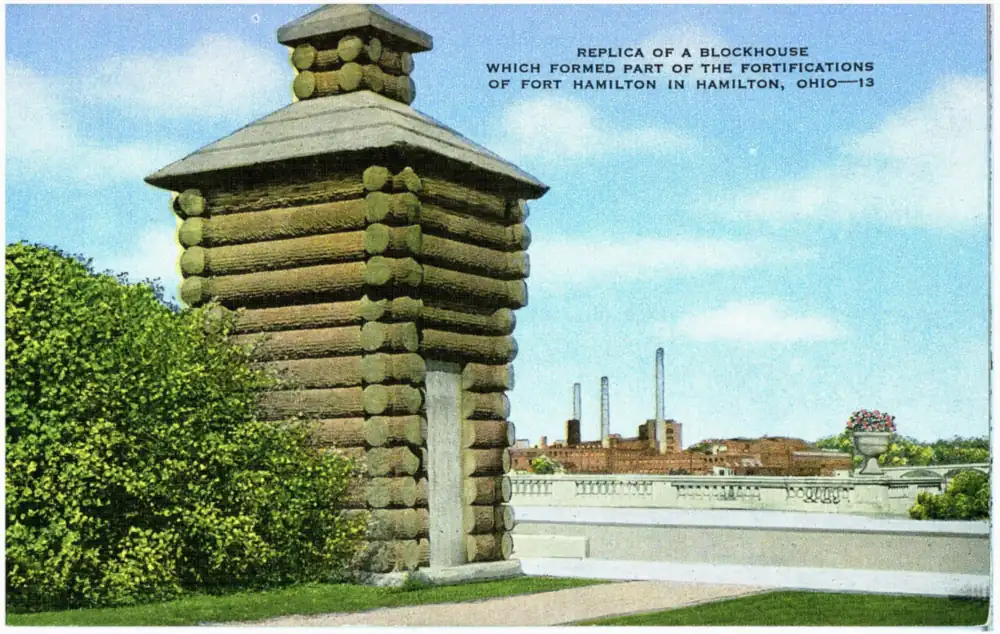
A replica blockhouse of the kind that anchored the fort's corners.Unknown author · No restrictions -
1792–1793
Northern and southern additions
Under General James Wilkinson the post is enlarged twice, gaining storehouses, a powder magazine and quarters — the fort at its largest, and the reason a civilian settlement of traders, teamsters and camp followers begins to thicken outside the pickets.
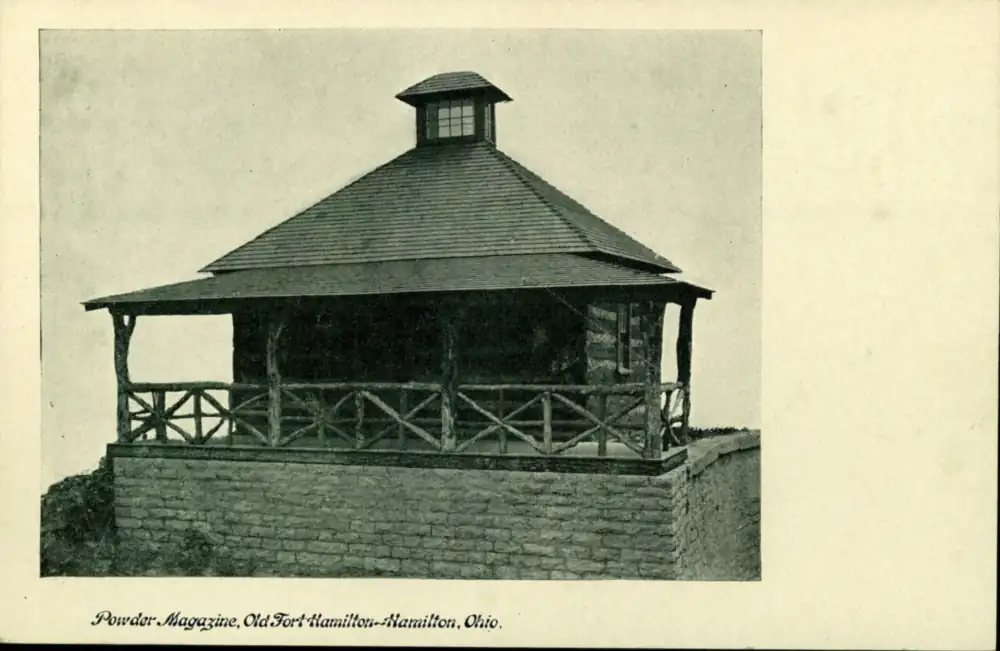
The powder magazine — for years the last standing fabric of the fort.Miami University Libraries · No restrictions 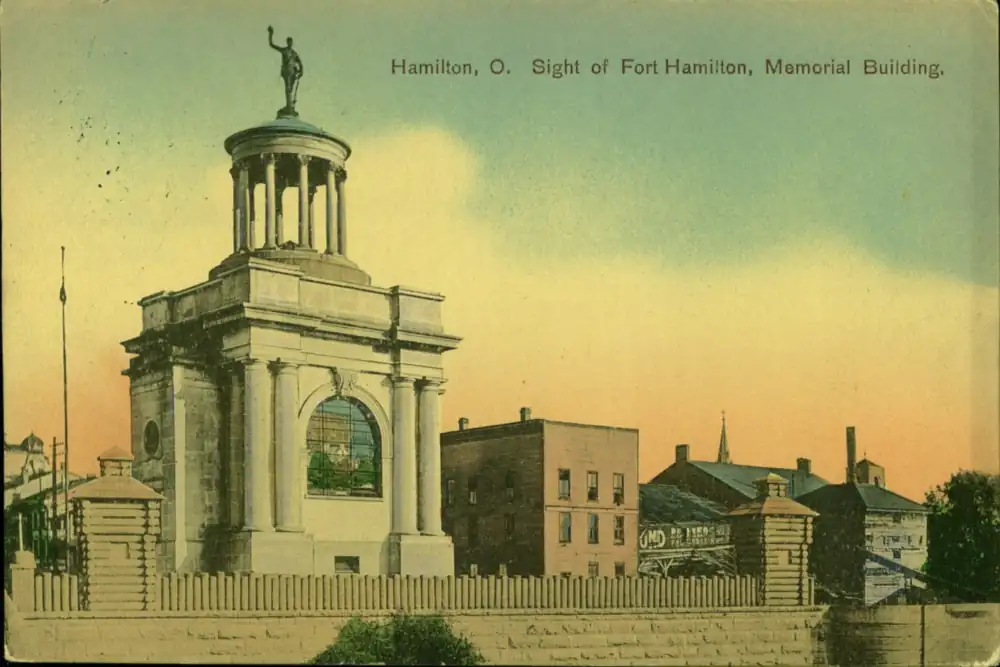
The fort's ground, long after: a postcard marking the site.Miami University Libraries · No restrictions -
1794–1796
The war ends and the fort is worth nothing
Anthony Wayne's victory at Fallen Timbers in August 1794 and the Treaty of Greenville that follows in 1795 open most of Ohio to white settlement. The military logic evaporates with it: by 1796 Fort Hamilton is being pulled down for its timber, and by 1800 the army is gone entirely.
What is left is the thing that actually mattered — a known crossing of the Great Miami on the road north from Cincinnati.
-
1795–1802
Israel Ludlow draws the streets
The land passes through John Cleves Symmes's Miami Purchase to Jonathan Dayton, and then to the surveyor Israel Ludlow, who lays out lots over the fort's own footprint. Ludlow's plat is formally recorded in 1802 — the town's legal birth, eleven years after its military one. The grid he ruled is still the grid of downtown Hamilton.
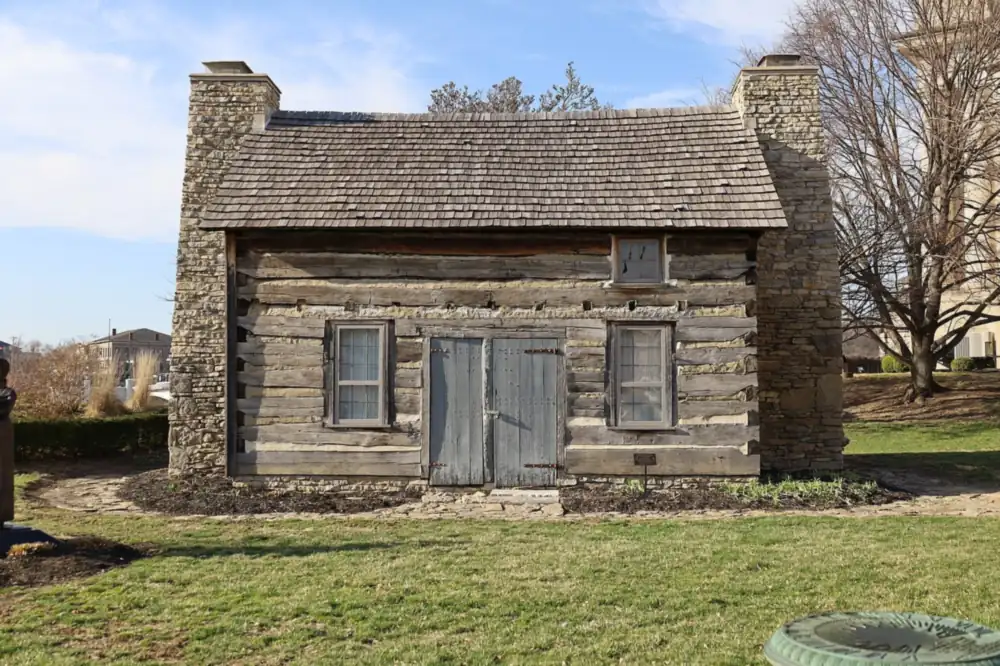
A surviving log house in Hamilton — the building vocabulary of Ludlow's first lots.Antony-22 · CC BY-SA 4.0
1803 — 1859
River Town, Canal Town
Two decisions made between 1825 and 1845, a state canal and a locally dug hydraulic channel, turn an agricultural county seat into a place that manufactures things. Almost everything Hamilton later becomes famous for follows from moving water sideways.
-
1803
Butler County, and a courthouse
Ohio becomes a state, Butler County is carved out, and Hamilton is made its seat — an administrative appointment that guarantees the town lawyers, records, taxes and traffic for the next two centuries. In 1810 the General Assembly formally incorporates it.
-
1817–1819
A bank, and a way across
The Bank of Hamilton is incorporated in 1817 with $300,000 in capital. Two years later the builder Nathan Hunt announces the region's first covered bridge over the Great Miami. Both are bets that the crossing will carry commerce, not just wagons.
-
1825–1845
The Miami Canal, then the Hydraulic
The state's Miami & Erie Canal reaches Middletown in 1825 and eventually runs 274 miles from Cincinnati to Toledo, putting Hamilton on a water route between the Ohio River and Lake Erie.
But the decisive work is local. Begun in 1842 and finished in 1845, the Hamilton Hydraulic diverts the Great Miami through a system of canals and reservoirs to sell cheap water power to whoever will build beside it. It works immediately: mills, foundries and paper works crowd the raceways, and Hamilton's fastest population growth of the century — 1840 to 1860 — runs on it.
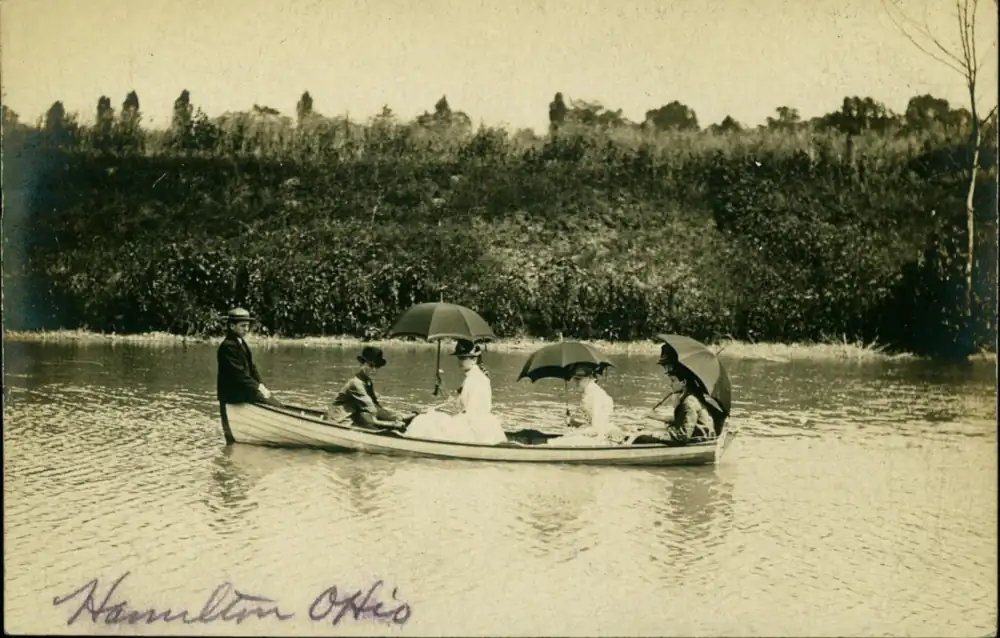
The canal — or the Hydraulic; in Hamilton the two words blurred.Miami University Libraries · No restrictions 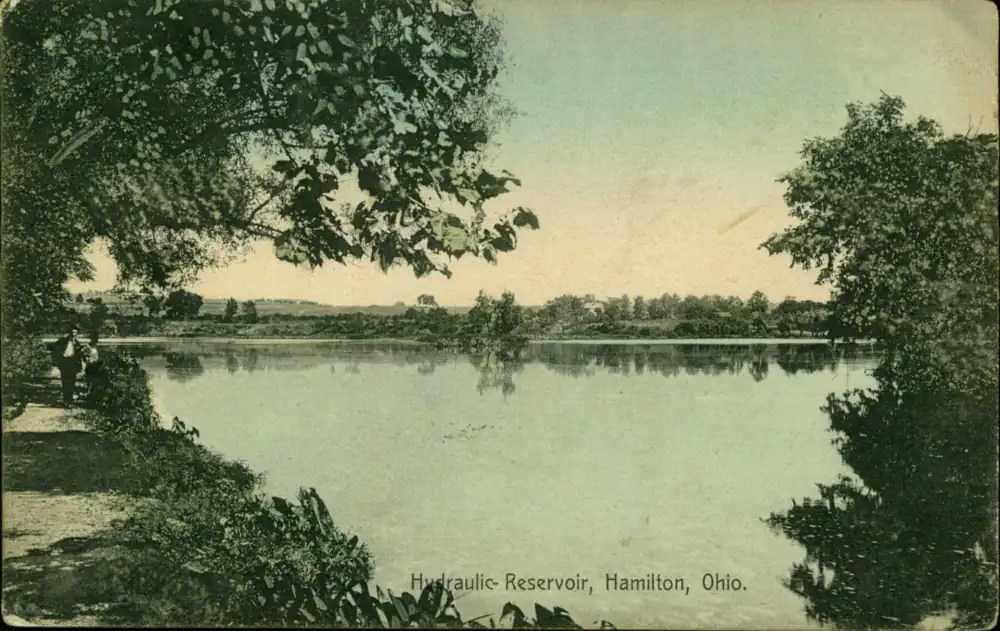
The hydraulic reservoir, the system's stored horsepower.Miami University Libraries · No restrictions 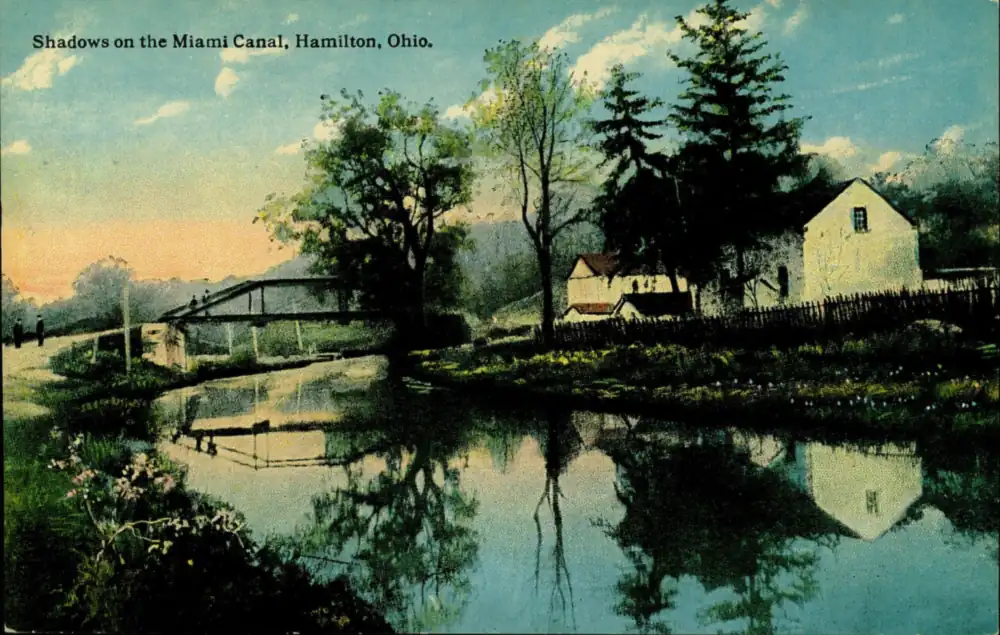
Once the mills went electric, the raceways became scenery.Miami University Libraries · No restrictions -
1840–1848
A boy on the Hydraulic who becomes the Dean of American Letters
The printer's family of William Dean Howells settles in Hamilton in 1840, and he spends his boyhood here until 1848. He would go on to write 35 novels, edit The Atlantic Monthly, champion Mark Twain and Henry James, and be called the Dean of American Letters. His Hamilton childhood — the canal, the swimming holes, the printing office — becomes A Boy's Town.
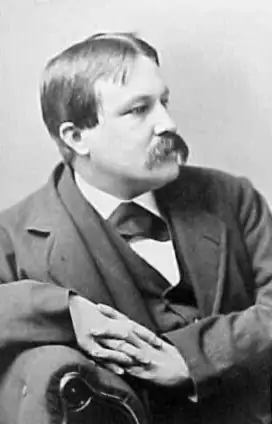
William Dean Howells, around 1870.Unknown author · Public domain 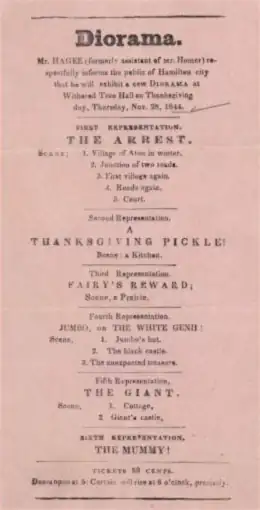
Thanksgiving 1844: a travelling diorama advertised at Withered Tree Hall — evening entertainment in Howells's Hamilton.Author unknown · Public domain -
1848–1854
Paper and iron take hold
Beckett Paper opens on the Hydraulic in the late 1840s — the beginning of a papermaking line that runs in Hamilton for more than 160 years. In 1854 the blacksmith's son Clark Lane helps found Owens, Lane & Dyer, building agricultural machinery, sawmills and papermaking machines, and starting the city's long run in heavy metals.
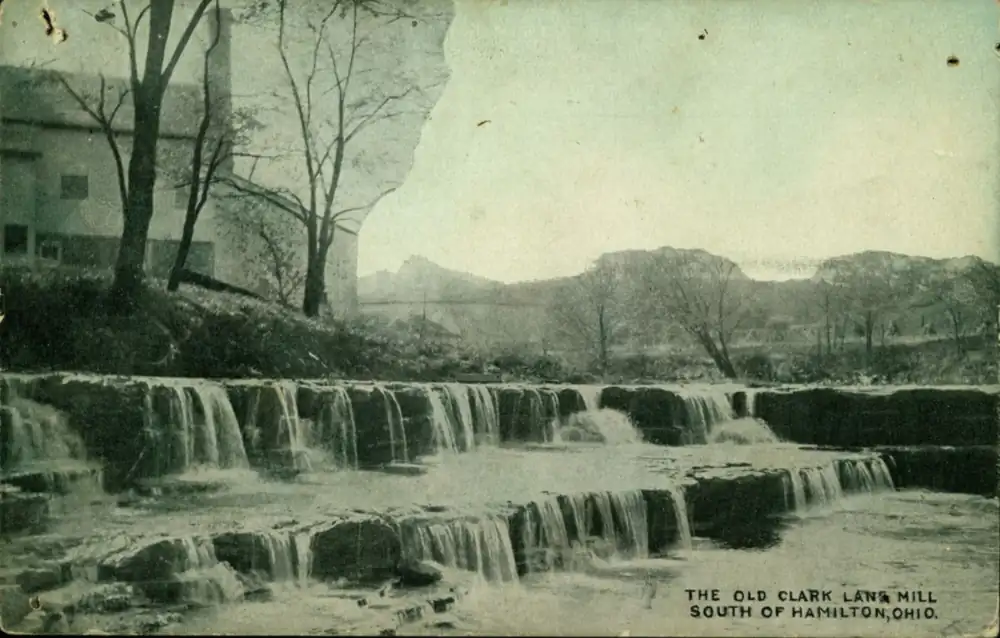
The old Clark Lane mill. Lane's machine money later bought the city a library.Miami University Libraries · No restrictions -
1854
Rossville comes across the river
The west-bank town of Rossville had dug a hydraulic of its own — but finished it after Hamilton's and never drew the same industry. In 1854 it gives up its independence and merges into the larger city. Hamilton becomes a town on both banks, which is why it needed so many bridges, and why losing them in 1913 cut it in half.
Why this page is addressed to 45013
Hamilton's ZIP codes run 45011–45015 and 45018. The one that covers the west bank — 45013 — still carries Rossville as its official accepted place name in the postal record. The town that voted itself out of existence in 1854 never quite left: it survives as a five-digit number.
-
1830s–1850s
The road through Butler County
Twenty miles north of the Ohio River, Hamilton sits on a working corridor of the Underground Railroad. Conductors Jack Jones and his son John S. Jones move people north from a tenant farm on the island between Hamilton and New Miami; by the late 1830s Charles Cheney, president of the Cincinnati and Hamilton Turnpike, is appointing tollgate keepers chosen for their sympathies. Freedom seekers move by night and, by day, disappear into the growing free Black community along the pike.
-
185917 Sept
Lincoln, from a railroad car
Campaigning through Ohio a year before his election, Abraham Lincoln speaks from a railroad car at South Fourth and Ludlow. He calls the Miami Valley around him the garden spot of the world — the kind of line a candidate says everywhere, except that in Hamilton they wrote it down and never stopped repeating it.
The garden spot of the world. Abraham Lincoln on the Miami Valley, Hamilton, 17 September 1859
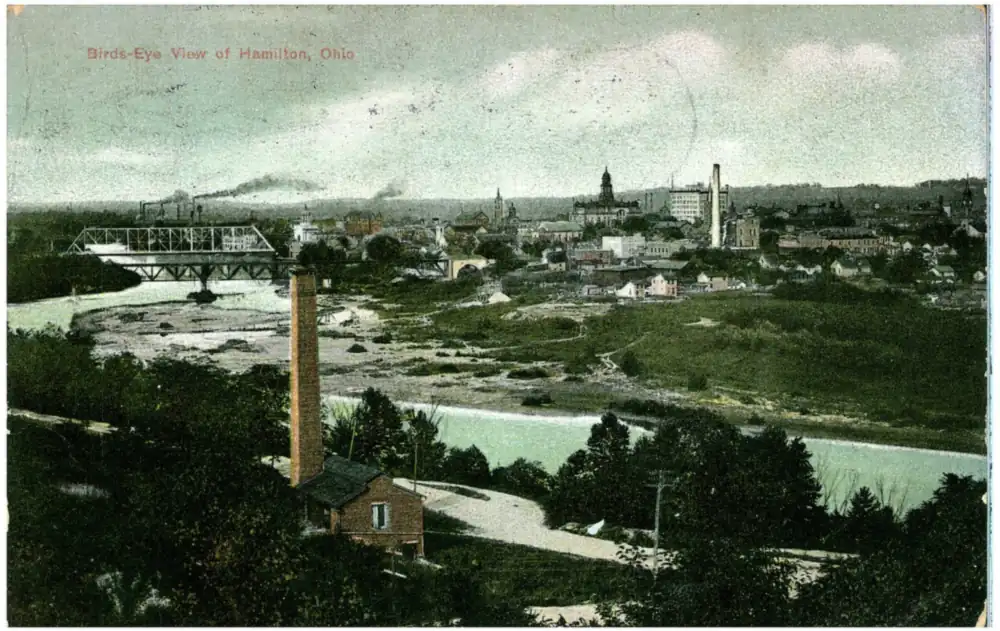
Hamilton from above, as the postcard trade liked to draw a river town.Unknown author · Public domain 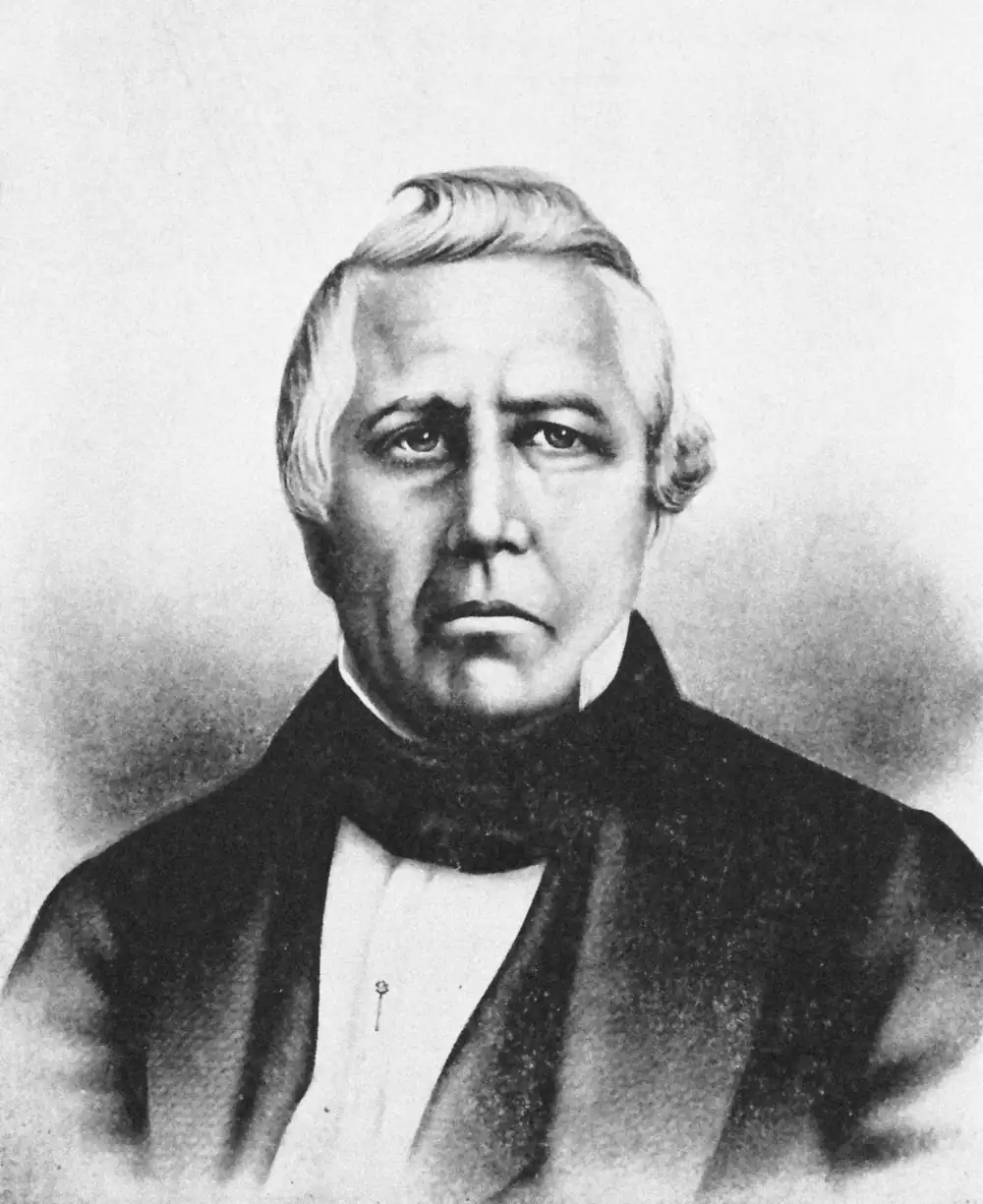
James McBride, the pioneer who wrote the town's early history down while its founders were still alive.Internet Archive Book Images · No restrictions
1860 — 1899
Forge, Foundry, Free Library
In forty years Hamilton acquires the industries that will define it for a century: machine tools, safes, engines and paper, plus one octagonal building that had no business existing in a town this size.
-
1861–1865
War, and a raid that never came
The 35th Ohio Volunteer Infantry organizes here in 1861. In the summer of 1863 John Hunt Morgan's cavalry raid across southern Ohio puts the whole Miami Valley on alarm — Hamilton musters, and Morgan passes to the east.
-
1866–1868
Clark Lane builds an octagon and gives it away
The machine manufacturer Clark Lane builds a Victorian octagonal library in 1866 and hands it to the people of Hamilton two years later. It is credited as the first free public library west of the Alleghenies — a free library in an industrial town, thirty-five years before Carnegie made the idea famous.
The 1913 flood ruins much of the building and its collection; it reopens in 1914 as Lane Public Library, survives a fire five years after that, and puts a bookmobile on rural roads in 1938.
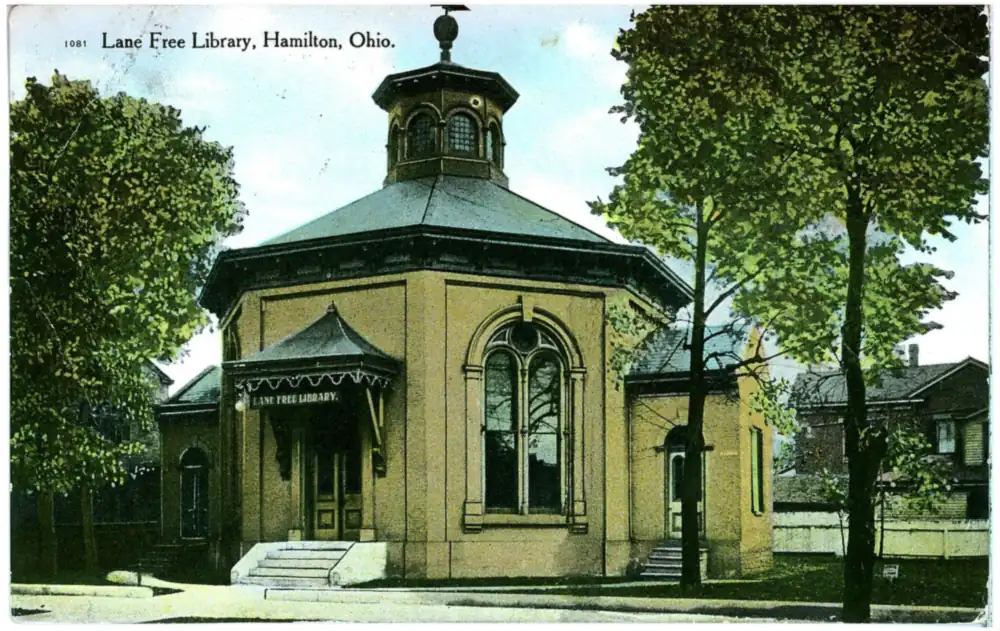
Lane Free Library. Eight walls, one idea: that a mill town's readers shouldn't have to pay.Unknown author · Public domain -
1872–1873
Niles Tool Works moves upriver
Founded in Cincinnati in 1845 by the brothers James and Jonathan Niles, the Niles Tool Works relocates to Hamilton in the early 1870s for its power, labor and rail. It builds the very large end of the trade — boring mills, planers, wheel lathes and forging equipment for railroads — and by the 1890s is turning out some of the biggest machine tools on earth.
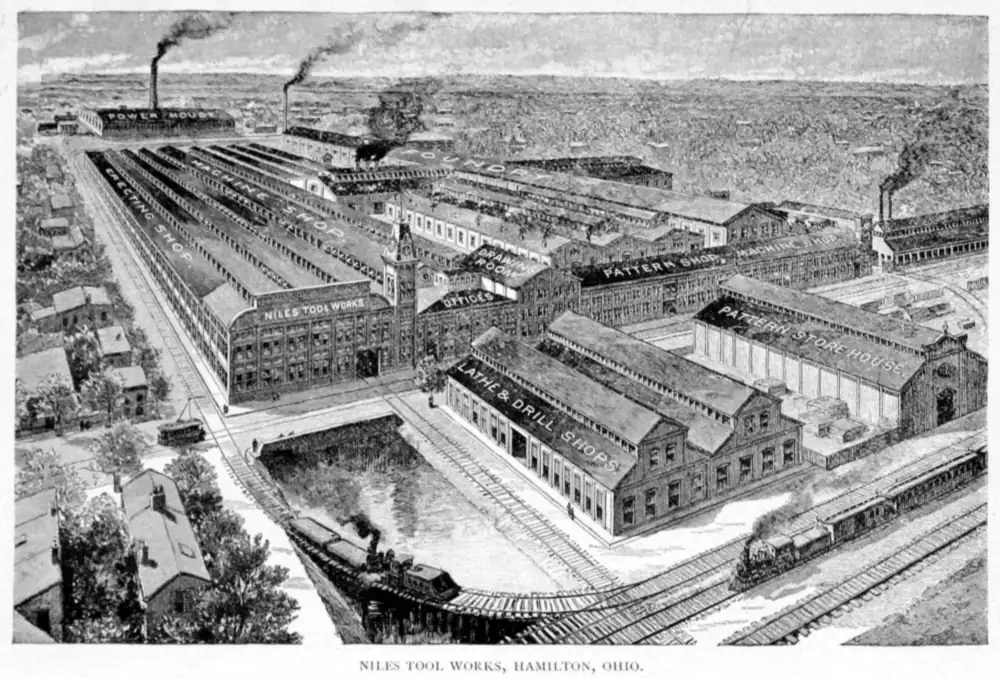
Inside Niles Tool Works, 1896 — a shop scaled to locomotive parts.Horace L.Arnold · Public domain 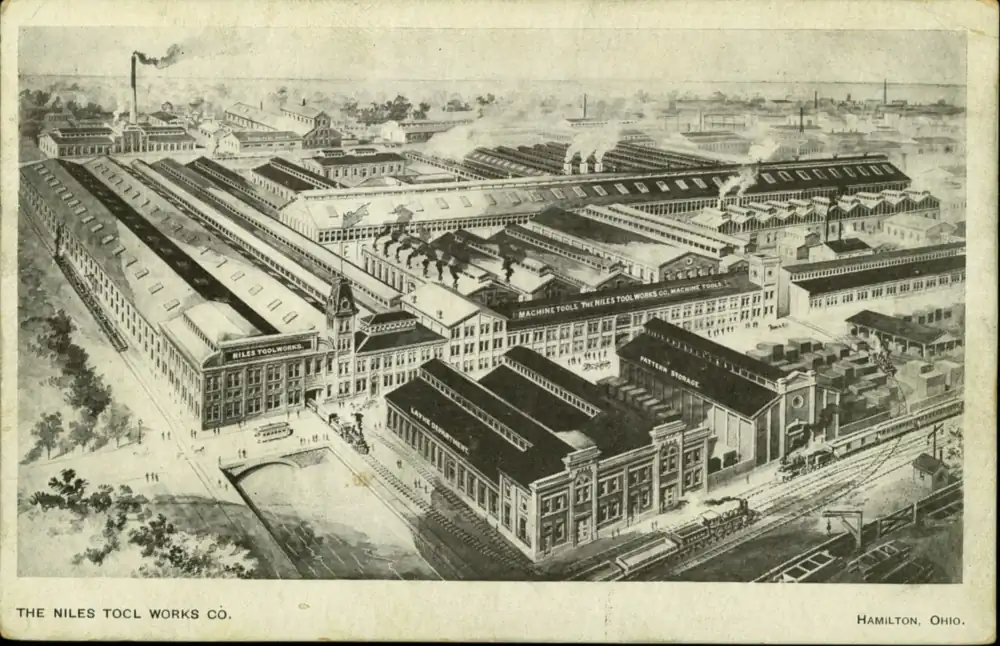
The works from outside, on a postcard sold downtown.Miami University Libraries · No restrictions -
1874–1891
Mosler moves the safe works upriver
After Gustave Mosler's death his family leaves the Cincinnati partnership he had co-founded in 1867, and in 1874 starts the Mosler Safe & Lock Company. It outgrows its Cincinnati plant, and in 1891 moves the whole operation to Hamilton — partly for room, and partly to get away from the Ohio River's habit of flooding the works.
Twenty-two years later the Great Miami would put their new town under eighteen feet of water. Alongside Herring-Hall-Marvin, Mosler nonetheless makes Hamilton the place American money is locked up in — and gives the city the title it liked best: the Safe Capital of the World.
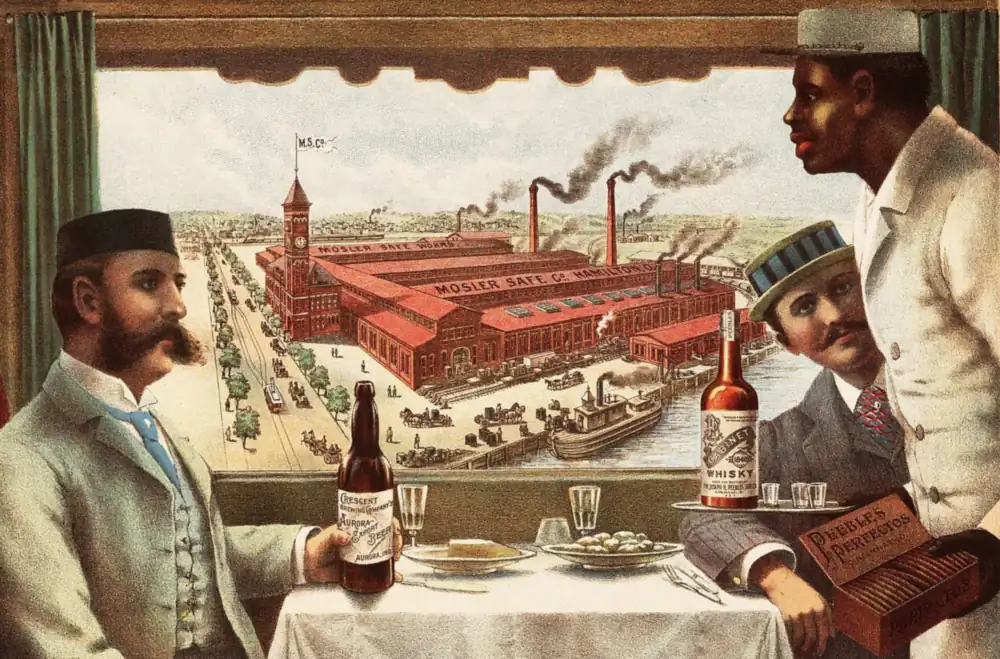
Mosler lithograph, 1894 — Strobridge & Co. printing muscle for a product nobody sees.Strobridge & Co. Lith. · Public domain 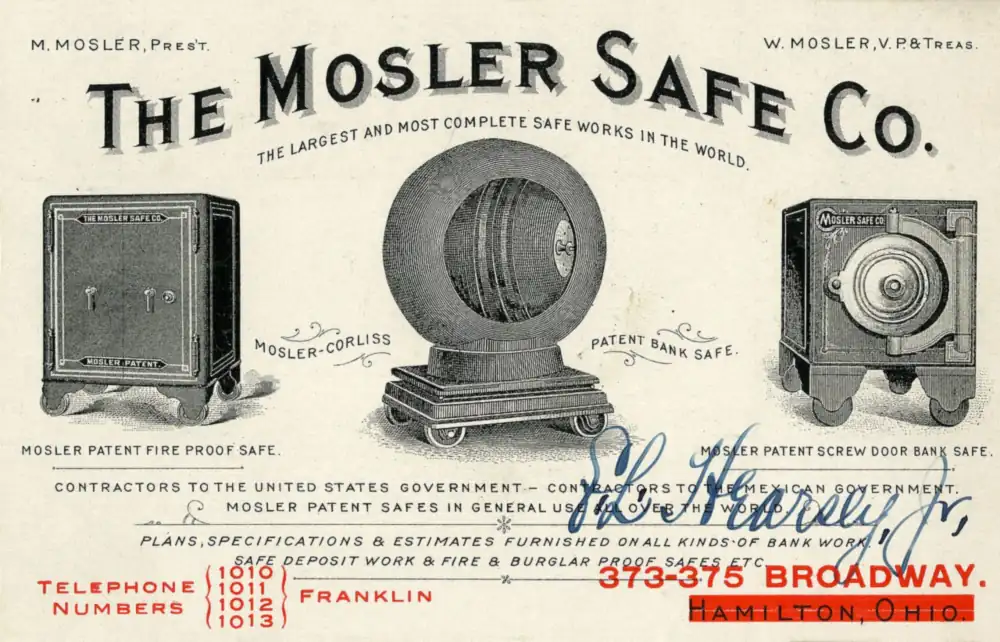
A Mosler trade card. Didone type, engraved borders, absolute confidence.Mosler Safe Company · Public domain 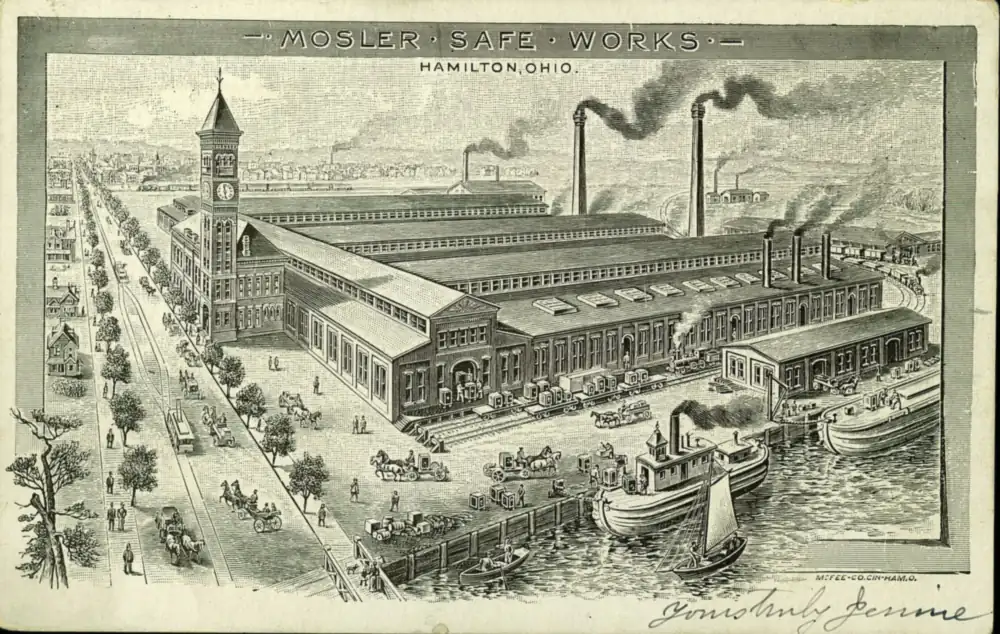
The Mosler works on East Hamilton Boulevard.Miami University Libraries · No restrictions -
1882
Hooven, Owens, Rentschler — engines
Successor to Job E. Owens's 1845 foundry, Hooven, Owens, Rentschler builds heavy stationary steam engines — Corliss engines, the machines that drove other people's factories. Sixty years later the same shop will build the engines for the first Liberty ships.
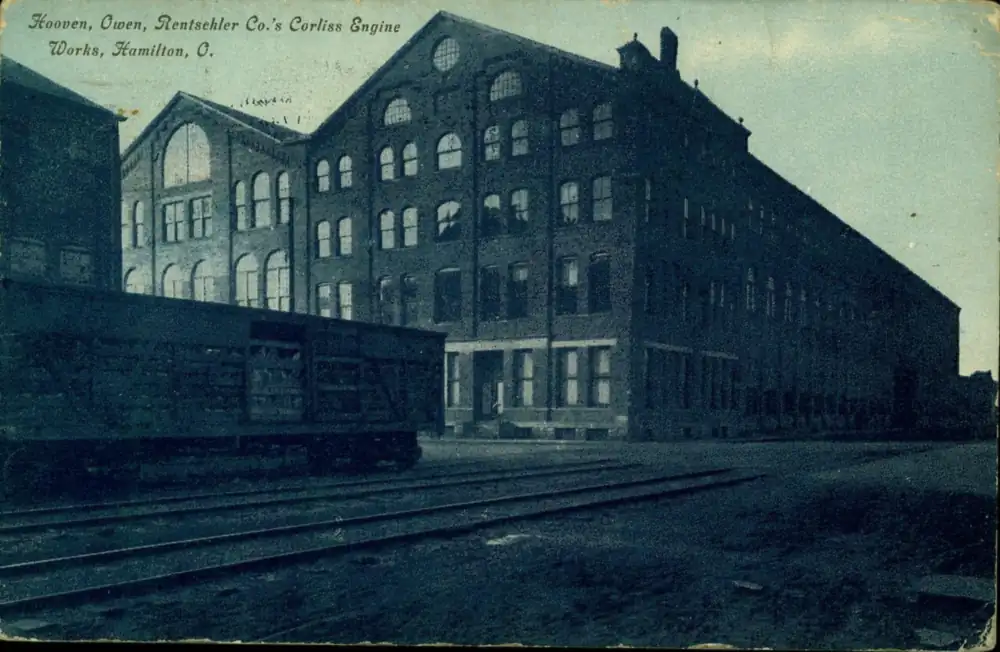
The Corliss engine works.Miami University Libraries · No restrictions 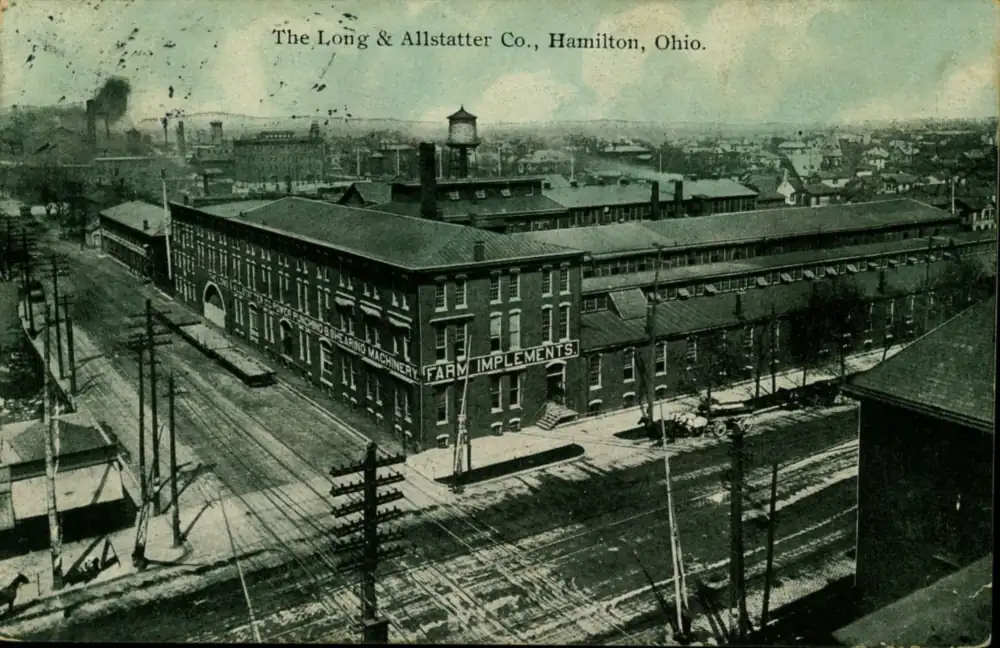
Long & Allstatter, one of dozens of metal shops on the raceways.Miami University Libraries · No restrictions -
1889–1895
A courthouse, a centennial, and electric light
A new Butler County Courthouse is completed in 1889. In 1892 the city publishes a fat commemorative volume for its centennial. In July 1895 Hamilton celebrates electric street lighting — and the water works and woollen mills and the rest of the apparatus of a confident industrial town appear on postcards as civic pride.
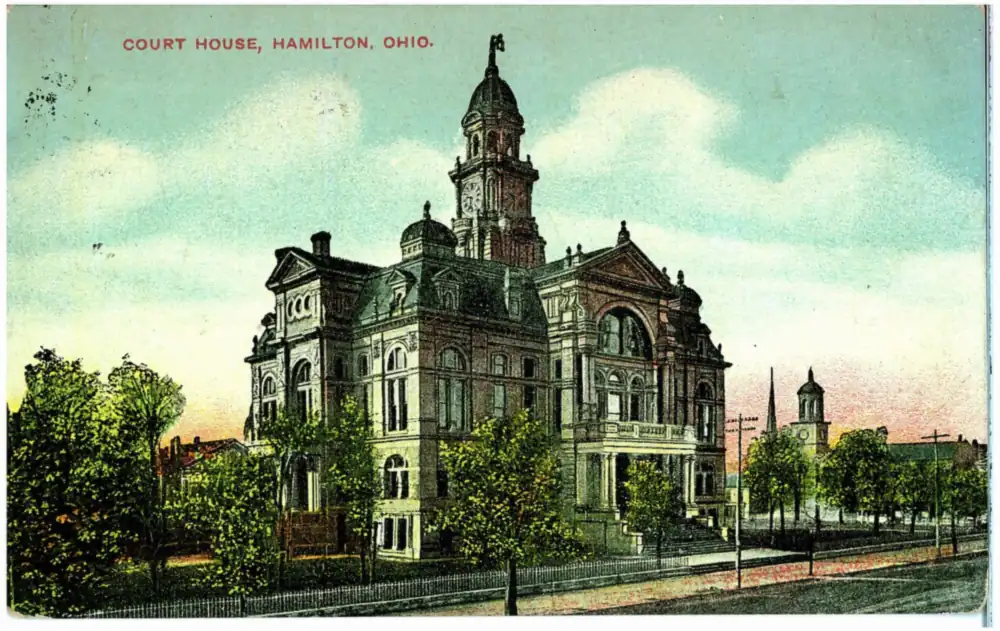
The 1889 courthouse — which burned in 1912.Unknown author · Public domain 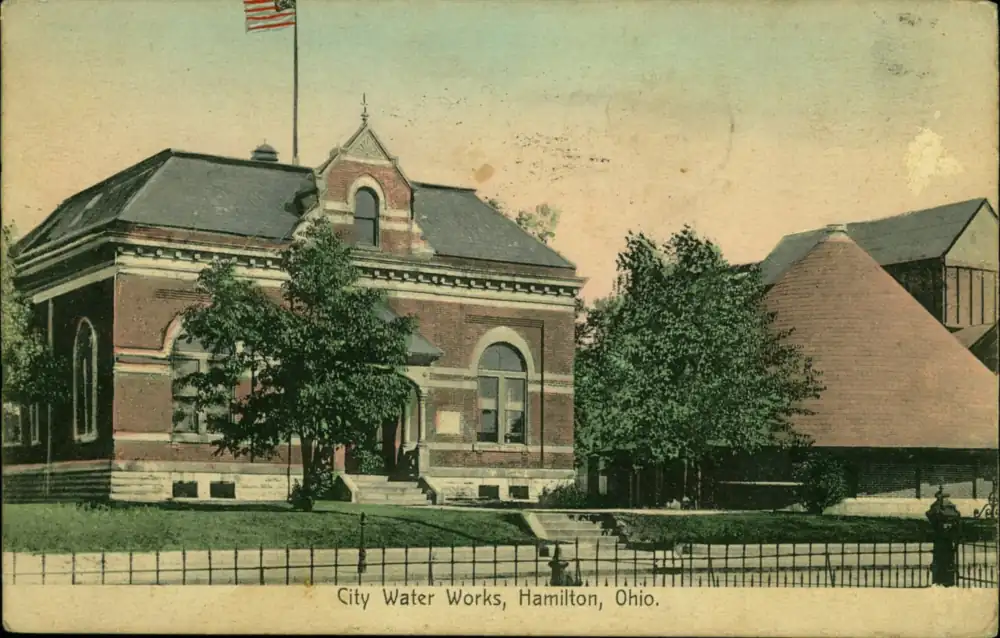
The city water works. Hamilton's water later won international taste competitions.Miami University Libraries · No restrictions 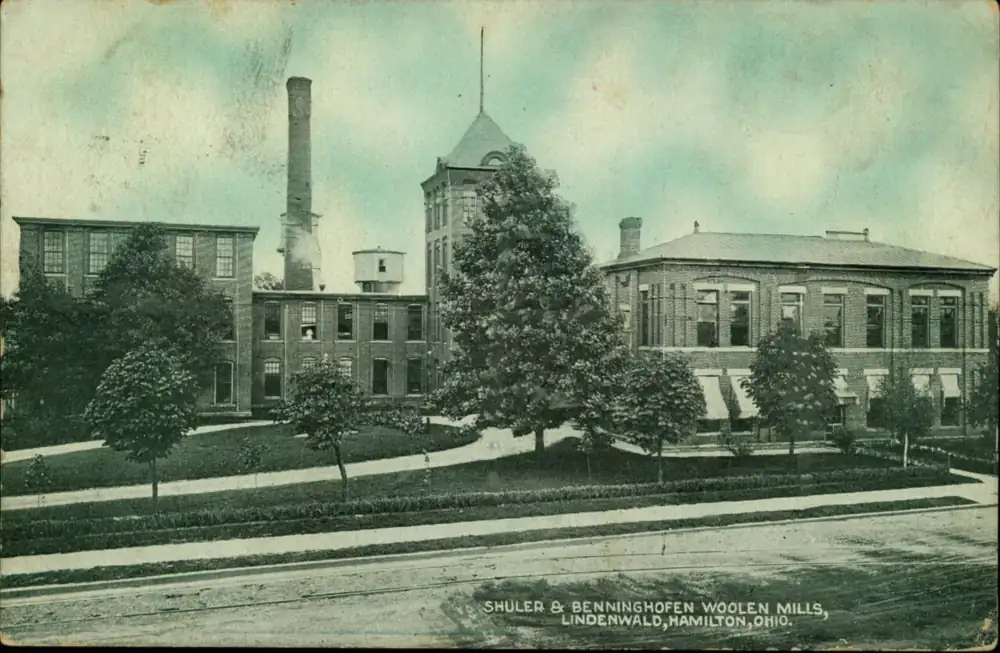
Shuler & Benninghofen woollen mills.Miami University Libraries · No restrictions 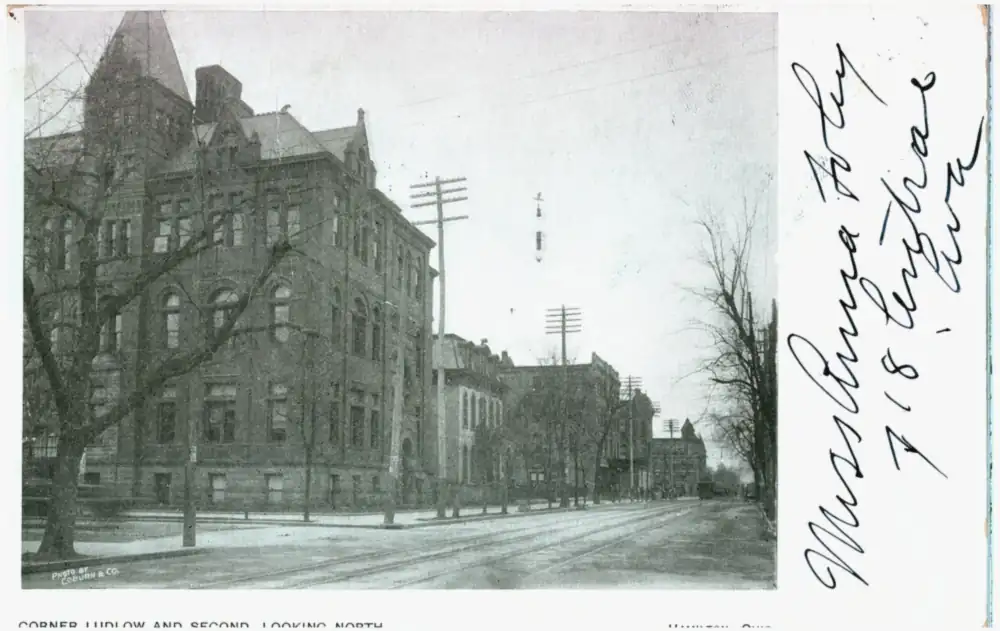
Ludlow and Second, looking north — Ludlow's 1802 grid, built up.Unknown author · Public domain
1900 — 1912
Safe Capital of the World
For a stretch of the twentieth century a town of 35,000 people held the world lead in three unrelated industries at once. These are the thirteen confident years before the water came.
-
1900
A farm boy who would measure earthquakes
Charles Francis Richter is born on 26 April 1900 on a farm at Overpeck, just north of Hamilton. He leaves for California as a teenager and in 1935, with Beno Gutenberg at Caltech, devises the magnitude scale that carries his name.
-
19064 July
The Soldiers' and Sailors' Monument
Dedicated on Independence Day 1906 at the head of the High–Main bridge, the monument becomes the city's fixed point — the thing every postcard photographer stood in front of, and the hinge between the two banks.
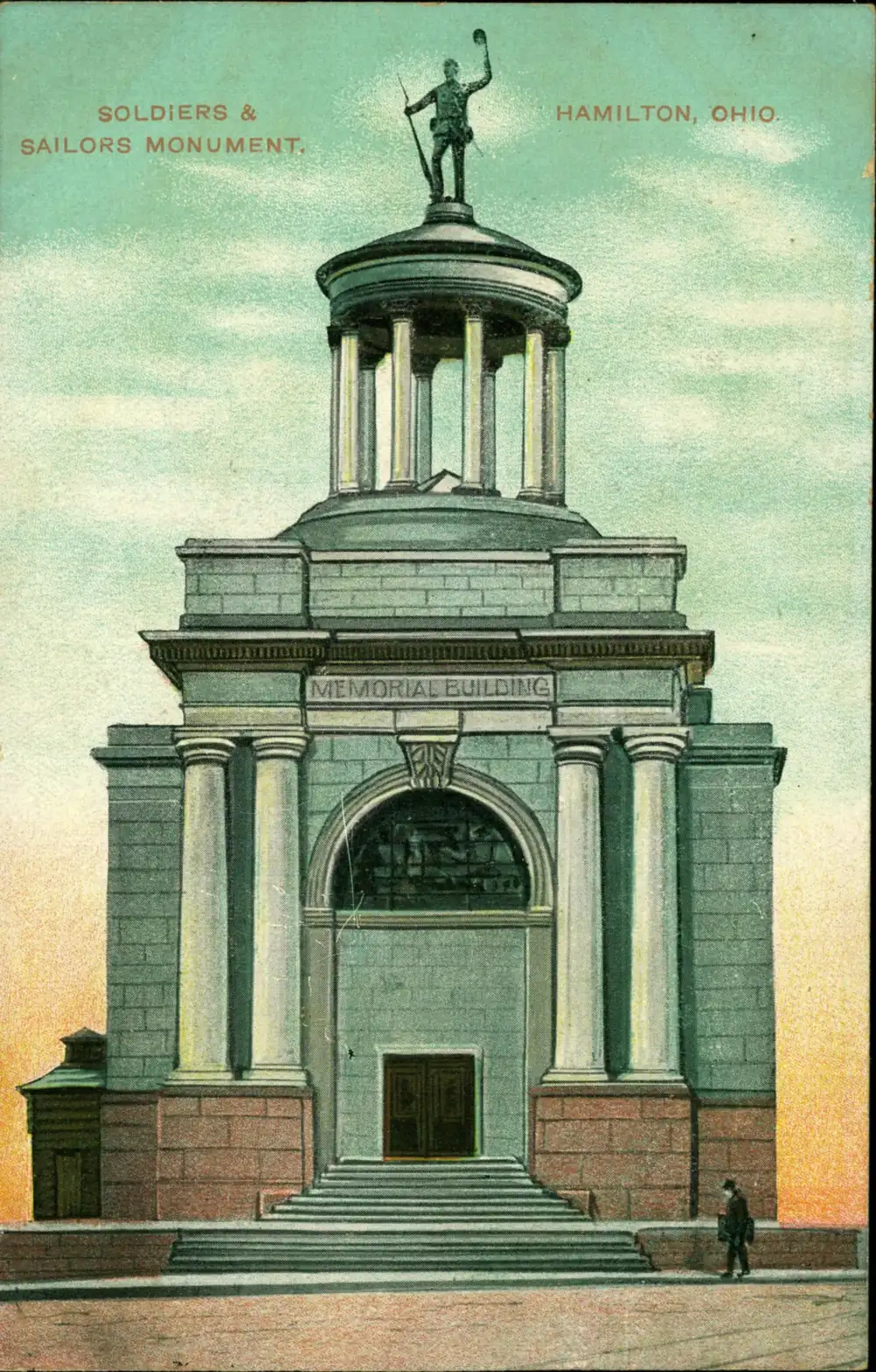
The monument, on a postcard. Bronze that has since gone the color of the river.Miami University Libraries · No restrictions -
1910
Champion becomes the largest coated paper mill on earth
Champion Coated Paper takes the world lead in coated paper in 1910. The product is worth understanding: coated stock is the glossy, clay-surfaced paper that made photographic reproduction possible. For decades, the magazines that showed America to itself were printed on paper made in Hamilton, Ohio.
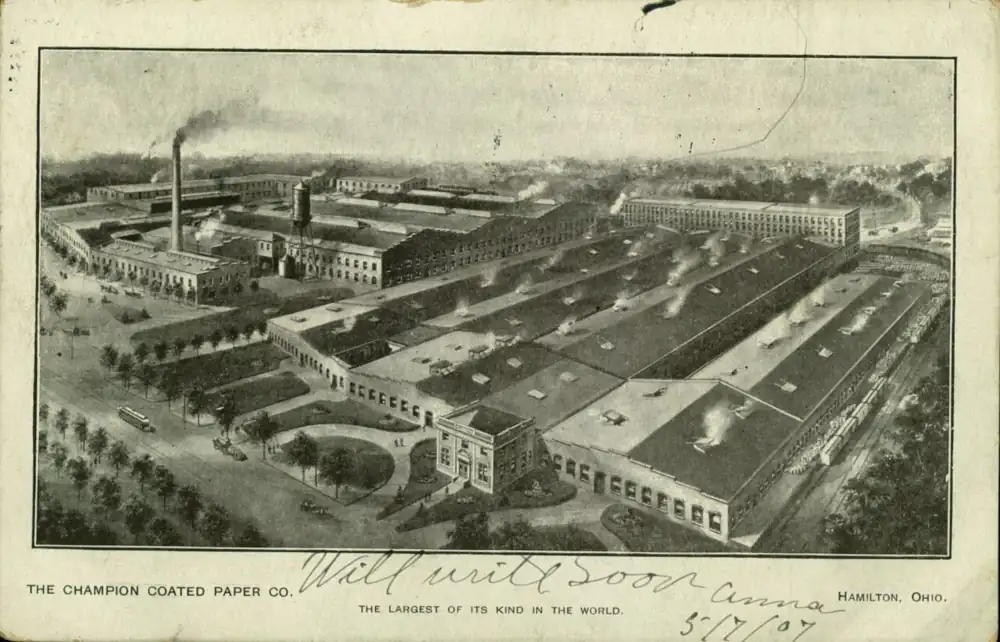
Champion Coated Paper — a mill the size of a neighbourhood.Miami University Libraries · No restrictions 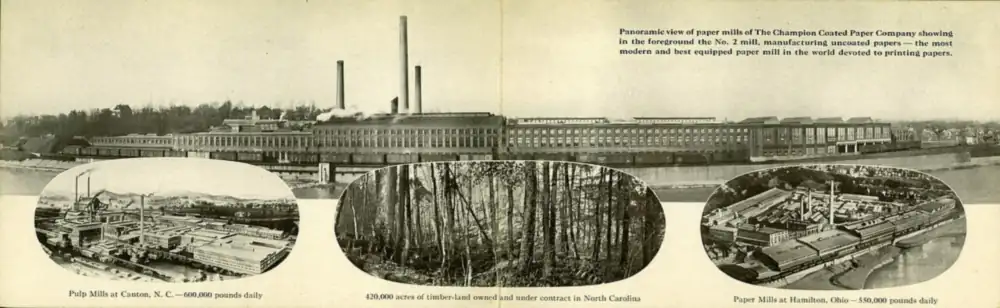
Panorama of the paper mills.Miami University Libraries · No restrictions -
1900s
What Hamilton made
By the 1940s the claim was extraordinary and, as far as anyone could tell, true: more than half the world's safes and vaults came from two Hamilton firms, the largest coated paper mill was here, and Niles was among the largest machine tool builders anywhere.
Safes & vaults
Mosler · Herring-Hall-Marvin
Together, more than half the world's safes and vaults. Hence the city's nickname.
Coated paper
Champion · Beckett
The glossy stock that magazines and advertising were printed on.
Machine tools
Niles Tool Works
Railroad-scale lathes, planers and boring mills.
Engines
Hooven, Owens, Rentschler
Corliss steam and, later, diesel — including Liberty ship power plants.
Steel & iron
Hamilton Steel & Iron
Rolling and coke works north of the city at New Miami.
Everything else
Stoves, cans, castors, woollens
Estate Stove, American Can, Black & Clawson, Shuler & Benninghofen.
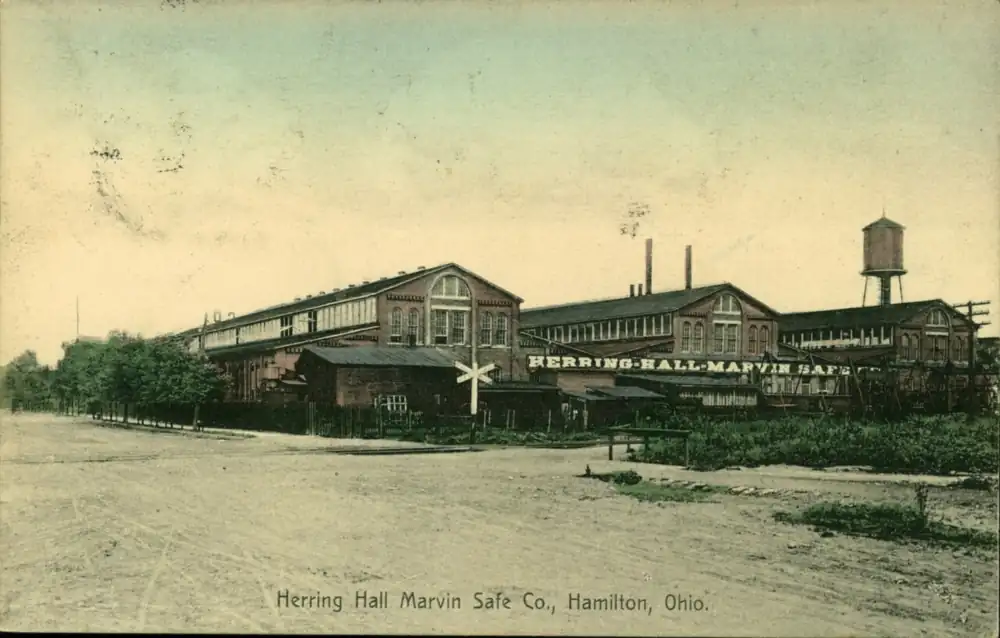
Herring-Hall-Marvin Safe & Lock.Miami University Libraries · No restrictions 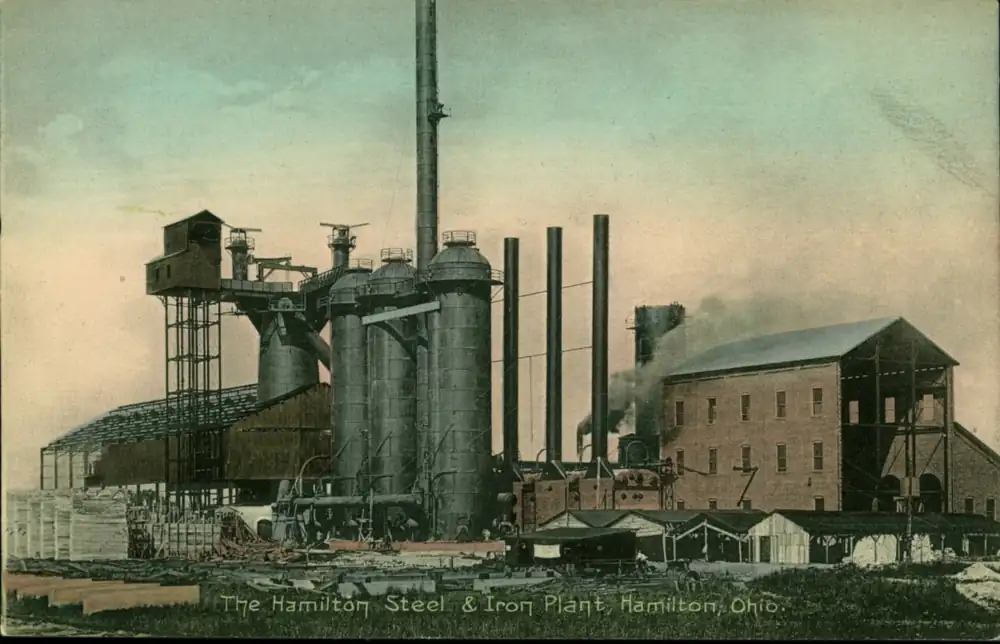
Hamilton Steel & Iron.Miami University Libraries · No restrictions 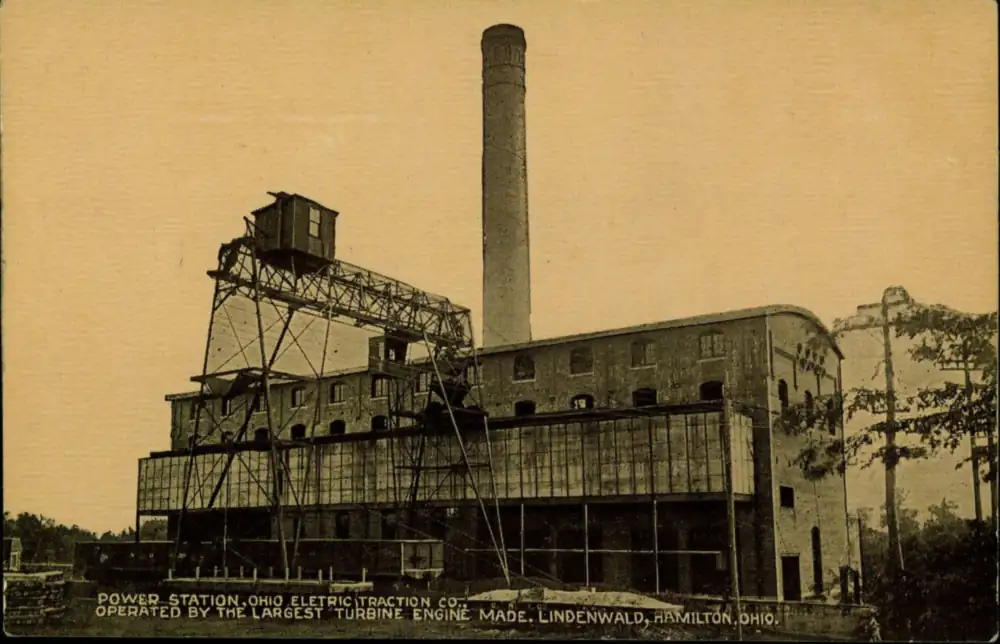
The Ohio Electric Traction Co. — interurban cars to Cincinnati and Dayton.Miami University Libraries · No restrictions -
1898–1911
High Street, dedicated and photographed
High Street is formally dedicated in early 1898, and for the next fifteen years it is the most photographed thoroughfare between Cincinnati and Dayton. A March 1898 flood kills ten people — a warning the city reads as an inconvenience.
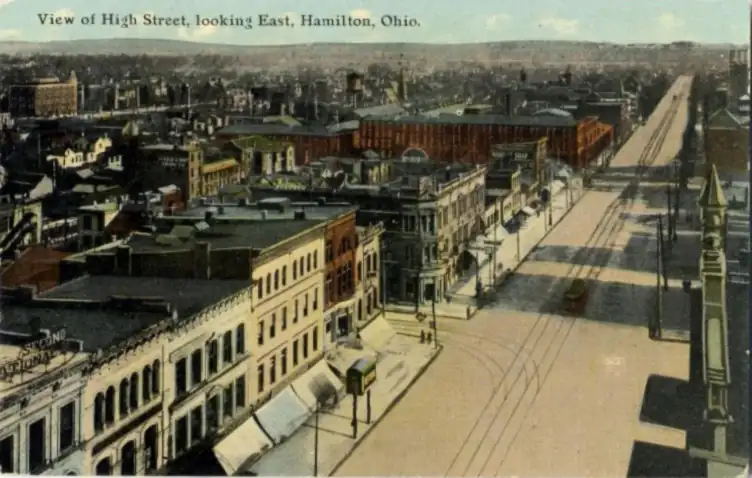
Main Street looking east, 1911.Unknown author · Public domain 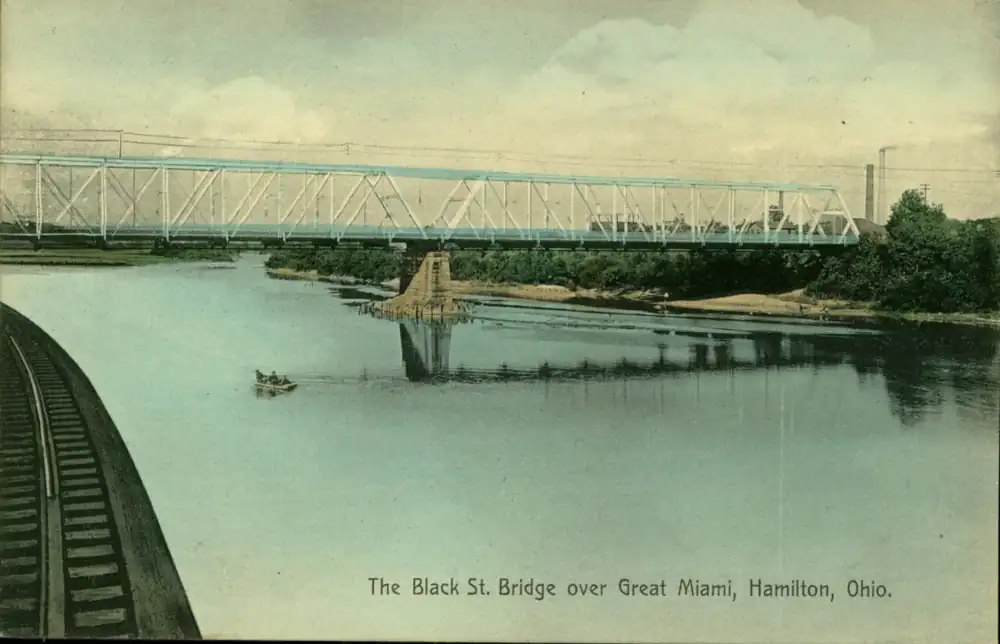
Black Street Bridge — one of the four the river would take.Miami University Libraries · No restrictions 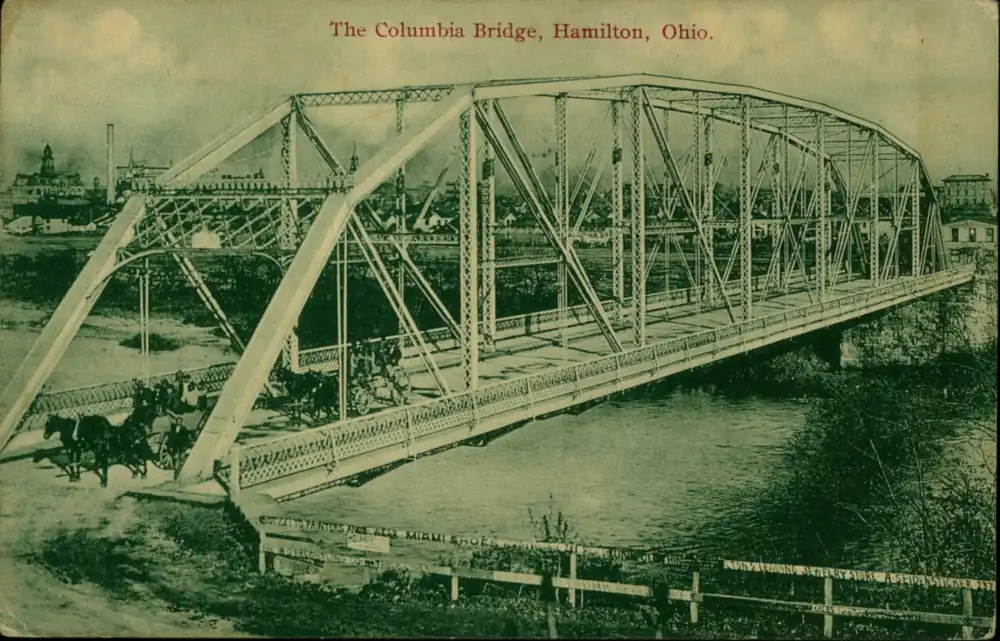
Columbia Bridge.Miami University Libraries · No restrictions -
191214 Mar
The courthouse burns
Fire destroys the Butler County Courthouse and kills three firefighters. It is the worst day in the city's recent memory, and it holds that title for twelve months and eleven days.
25 — 27 March 1913
The Flood
Ohio's greatest weather disaster. Five days of rain on saturated ground sent the Great Miami over its banks through the whole valley. Hamilton, built on both sides of the river, took it worse than almost anywhere.
-
25 Mar1913
Four bridges in one afternoon
The river rises through Easter week. At Hamilton it takes three of the four bridges within two hours, and the fourth a few hours later — severing Rossville and the west bank from downtown at the moment everyone needed to cross. Water stands ten to eighteen feet deep in the low-lying East Side. More than four-fifths of the city goes under.
~200
lives lost in Hamilton
≈360 in the Miami Valley
10,000
left homeless
of a city of ~35,000
4 / 4
bridges destroyed
three within two hours
18 ft
maximum depth in streets
East Side residential
Depth of standing water in Hamilton streets. The dashed line is 10 feet; the solid line is 18 — the reported maximum in East Side residential blocks.
For scale: a single-storey house is roughly 10 feet to the eaves.
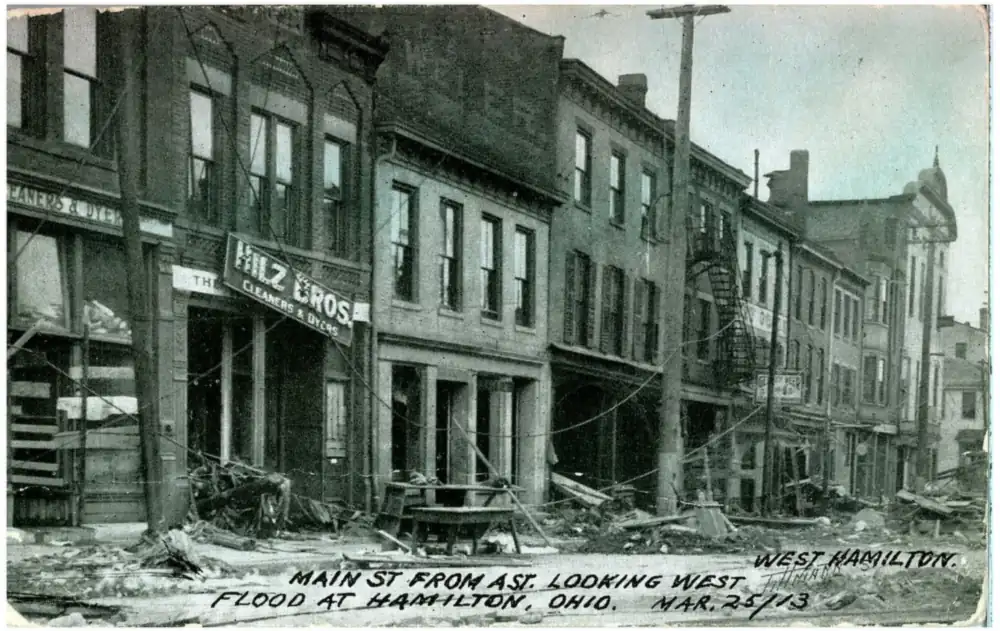
Main Street from A Street, looking west, 25 March 1913.Unknown author · No restrictions 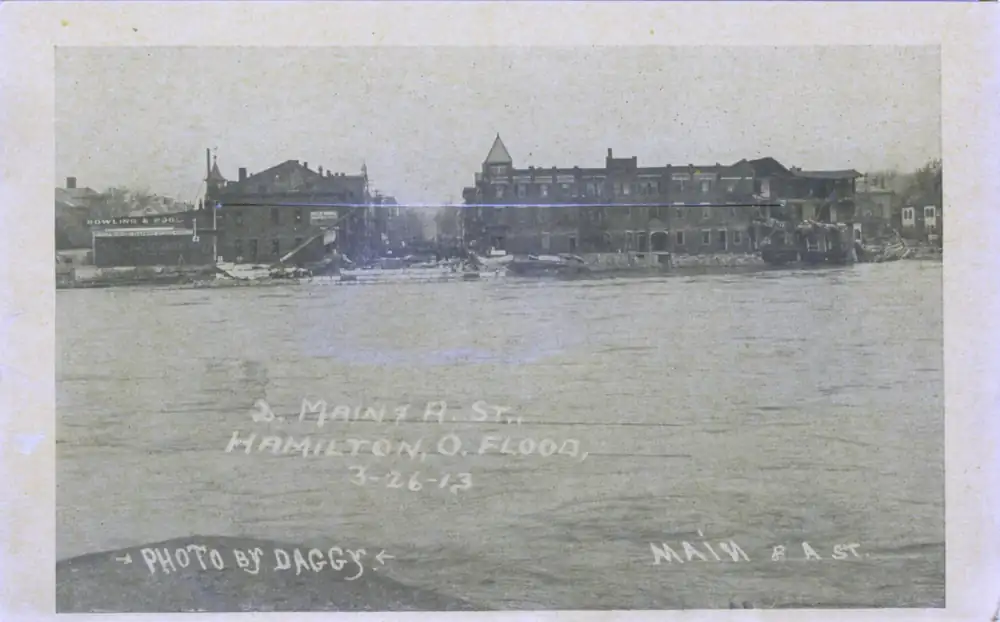
A composite of flood views, sold as a postcard within weeks.Miami University Libraries · No restrictions 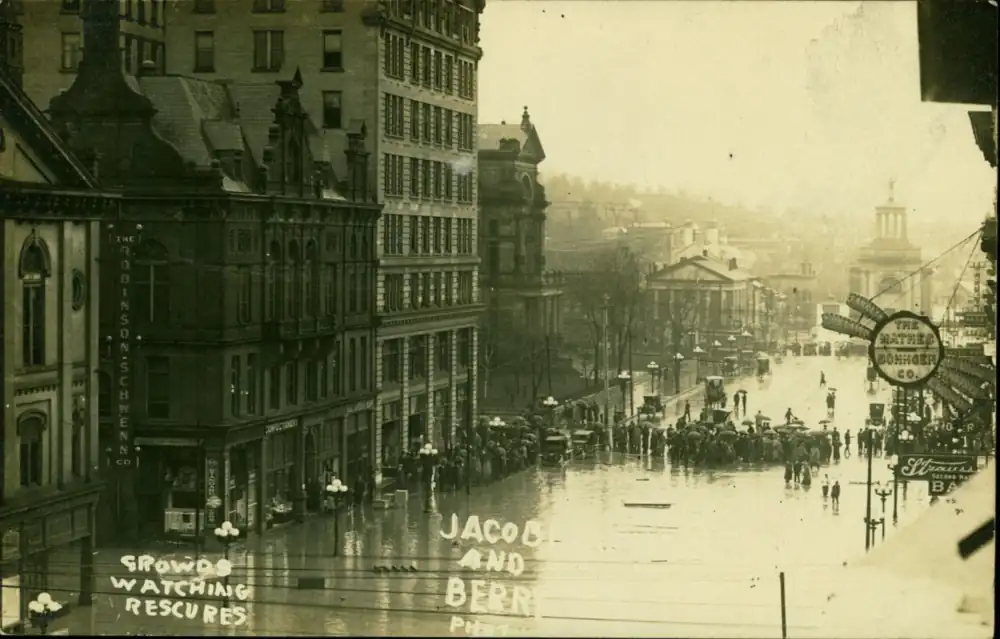
Crowds watching the rescuers.Miami University Libraries · No restrictions 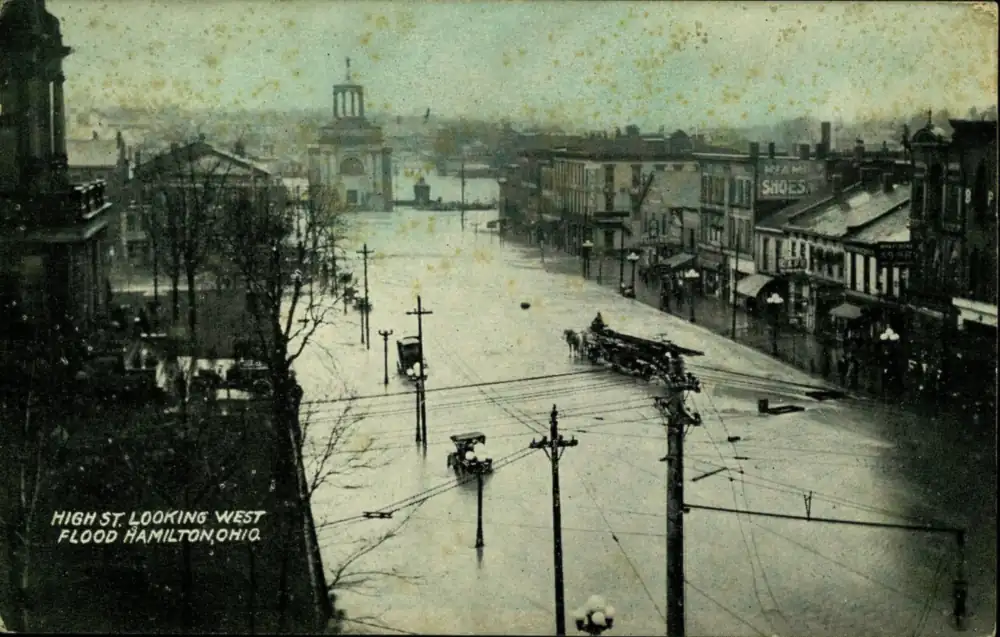
High Street looking west — filed in the archive under floods, flood damage, disasters. The same view the postcard trade had spent a decade selling as prosperity.Miami University Libraries · No restrictions -
25 Mar1913
The mill burns while it floods
Part of the Champion works catches fire during the flood and burns while surrounded by water — the era's defining photograph of Hamilton, and a fair summary of the week.
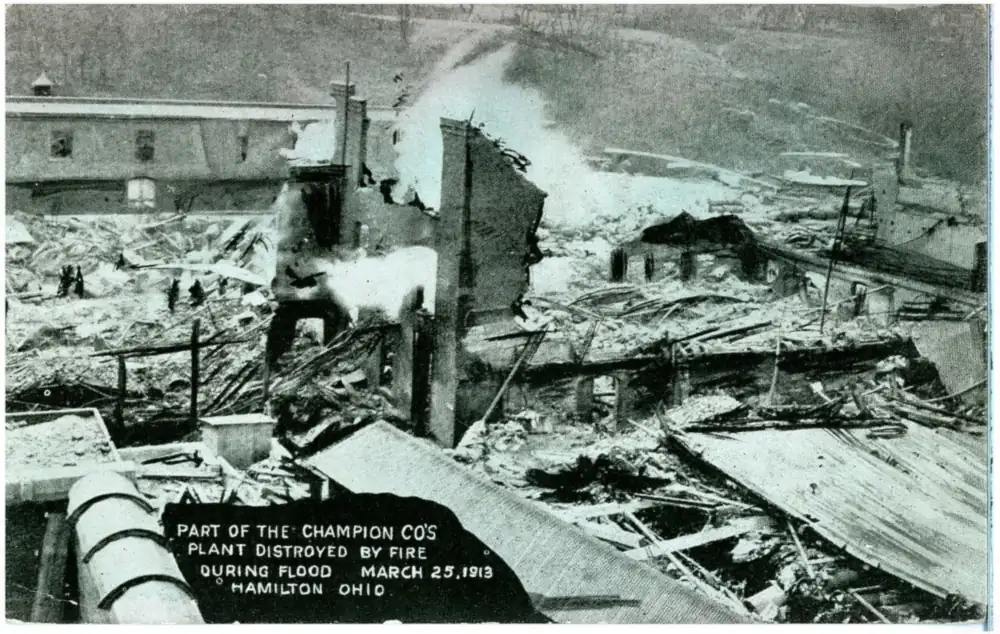
Part of the Champion Company's plant, destroyed by fire during the flood, 25 March 1913.Unknown author · Public domain -
1913after
A town on pontoons
With every bridge gone, Hamilton crosses its own river on a pontoon bridge — which the river then wrecks as well. Rebuilding the crossings is the first order of civic business, and the new spans go up heavier and higher than the ones they replace.
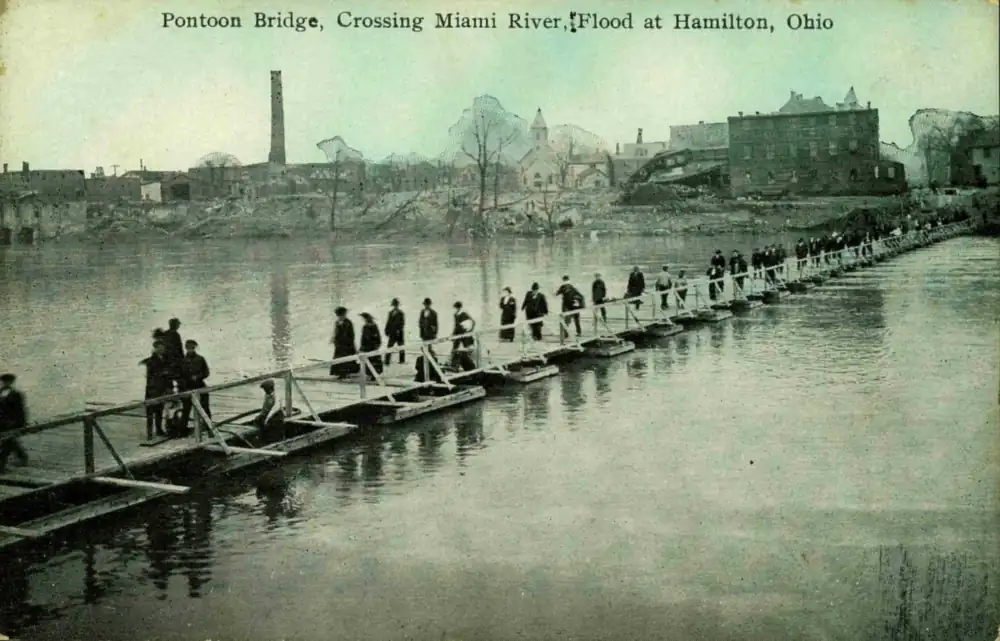
The pontoon bridge — the only way across.Miami University Libraries · No restrictions 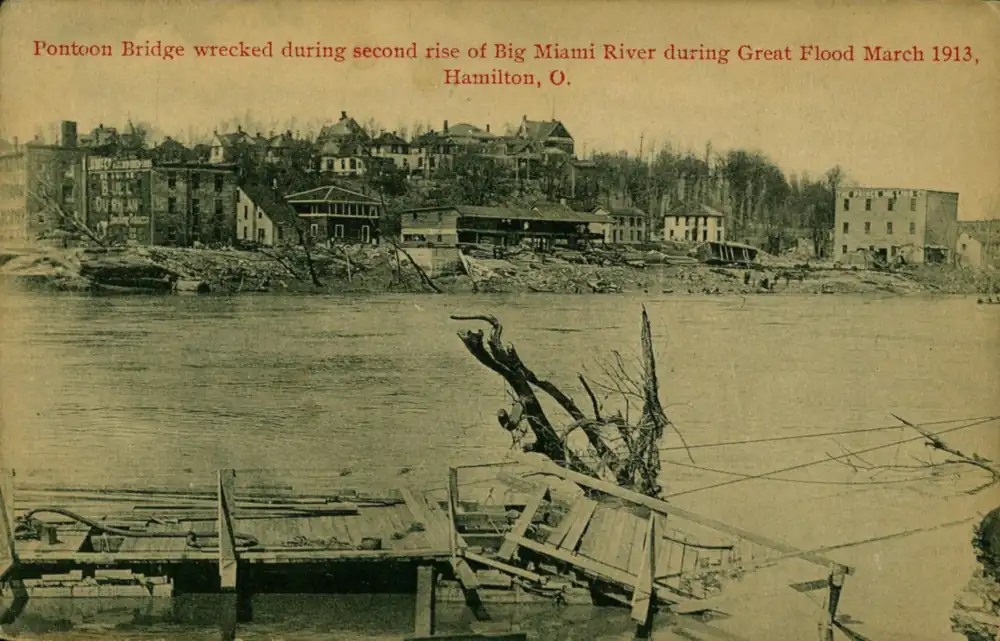
And the pontoon bridge, wrecked.Miami University Libraries · No restrictions 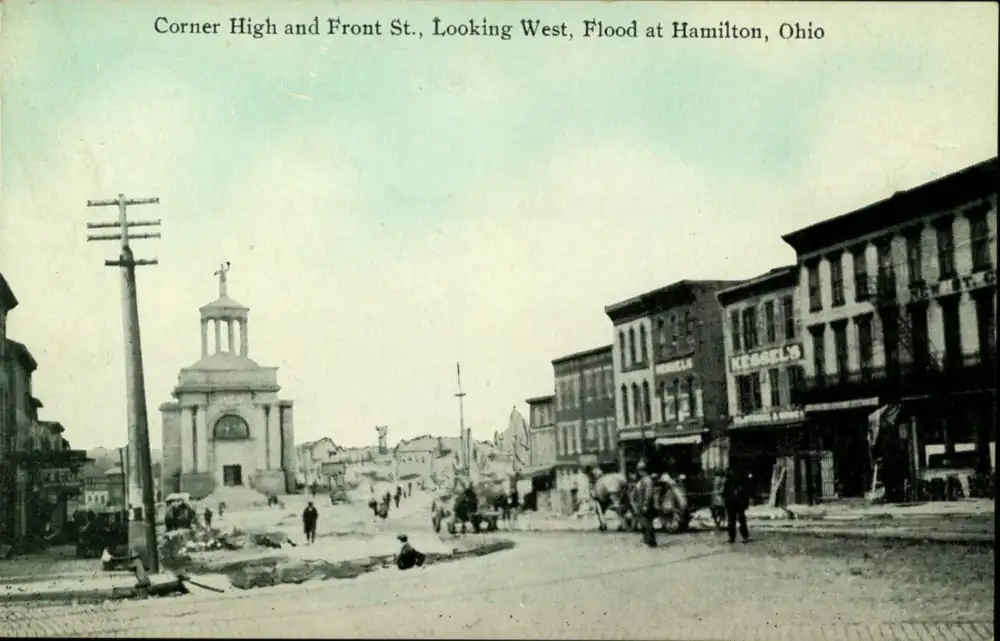
High and Front Streets, looking west, at the foot of the monument — the mud line after the water dropped.Miami University Libraries · No restrictions -
1915–1922
The answer: engineer the whole watershed
Survivors do something unusual with their grief — they organize. The Miami Conservancy District, created in 1915, is the first watershed-scale flood control district in the United States: five dry dams, channel work and levees across some 65 miles, built to hold a storm larger than 1913's. It becomes the model for federal flood control that follows.
The Great Miami has never again done to Hamilton what it did that Easter week. The river is still there; the argument with it was settled by concrete.
1914 — 1969
Arsenal and Apex
Two wars, one spectacularly corrupt decade, and the highest population the city has ever recorded. Hamilton's peak is a wartime peak, and it does not survive the peace by long.
-
1918Oct
Influenza
The pandemic reaches Hamilton in October 1918, overwhelming hospitals and closing schools, churches and businesses — five years after the flood, in a city still rebuilding.
-
1920
Henry Ford opens a plant
Ford's Hamilton plant opens in April 1920 to build Fordson tractor parts, and within months switches to lock parts and wheels for the Model T — a recognition that Hamilton had the metalworking labor Ford needed. In the Second World War the plant makes bomber engine parts; Bendix Aviation buys it in 1951.
-
1920–1933
Little Chicago
Prohibition turns Hamilton into a way station on the liquor routes, close enough to Cincinnati and quiet enough to work from. Chicago men keep second homes here. John Dillinger is said to have used a hideout on Second Street. There are slot machines in business basements, weekly payments to stay open, car bombs outside downtown speakeasies, witnesses who don't make it to trial — and a police department widely assumed to be in on it. The nickname sticks for good: Little Chicago, and the corruption outlasts Prohibition by twenty years.
In 1926 voters approve a charter form of government, effective 1928 — a reform impulse in a city that badly needed one.
-
1941–1945
The engines of the Liberty fleet
Hooven, Owens, Rentschler — by then a division of General Machinery — adapts the British triple-expansion design for American production and builds the main engine of Ocean Vanguard, the first of the Liberty ships: 2,500 indicated horsepower from cylinders 24½, 37 and 70 inches on a 48-inch stroke. The plainest possible statement of what Hamilton was for.
The city runs air-raid zones, blackout ordinances and sugar rationing; in 1944 it collects 22 tons of tin cans. By 1946 residents have bought more than $108 million in war bonds.
-
194410 June
A fifteen-year-old pitches in the major leagues
With rosters emptied by the draft, the Cincinnati Reds send Joe Nuxhall of Hamilton to the mound at fifteen years old — still the youngest player ever to appear in a Major League game. He returns after the war for a long career, then spends nearly four decades calling Reds games on the radio.
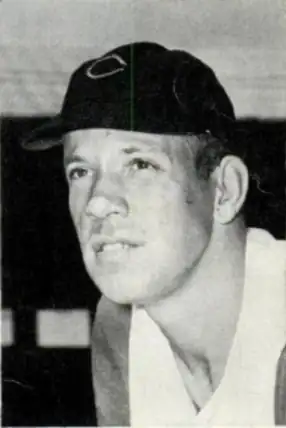
Joe Nuxhall, 1957 — thirteen years after his debut, and still only 29.Unknown author · Public domain -
1930s–1940s
The rebuilt city, printed on linen
By the time the linen-textured postcards of the thirties and forties are being sold, Hamilton has replaced everything the water took. The four bridges are back — heavier, higher, and photographed from the same spot as their predecessors — with Champion's stacks behind them. It is a town advertising its own recovery, twenty-five years on.
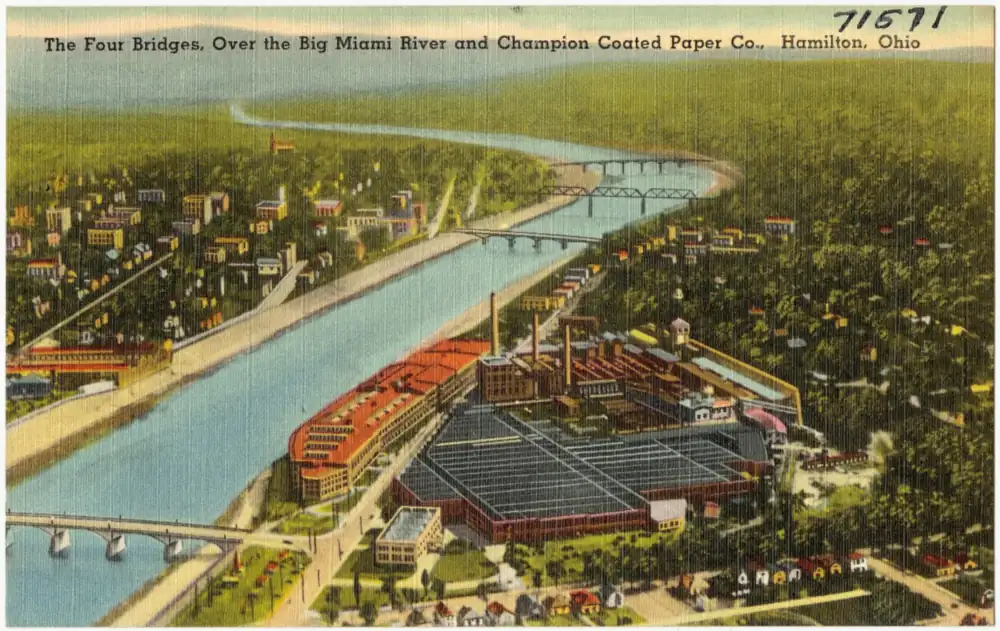
The four bridges over the Big Miami, with Champion Coated Paper beyond — the replacements for the four lost in 1913.Wargo News Co., Hamilton · Public domain 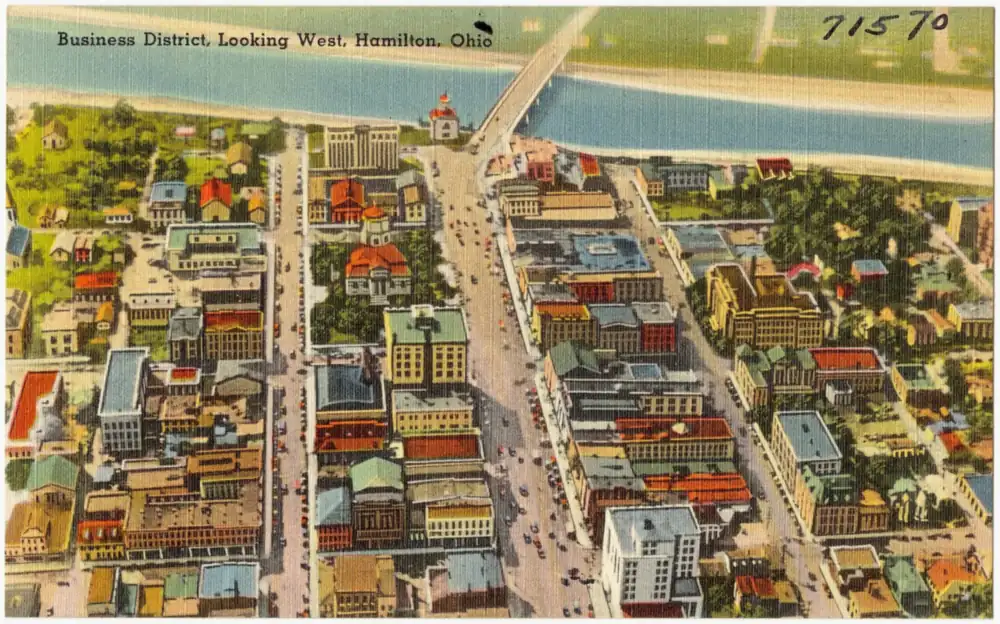
The business district, looking west toward the crossing.Wargo News Co., Hamilton · Public domain 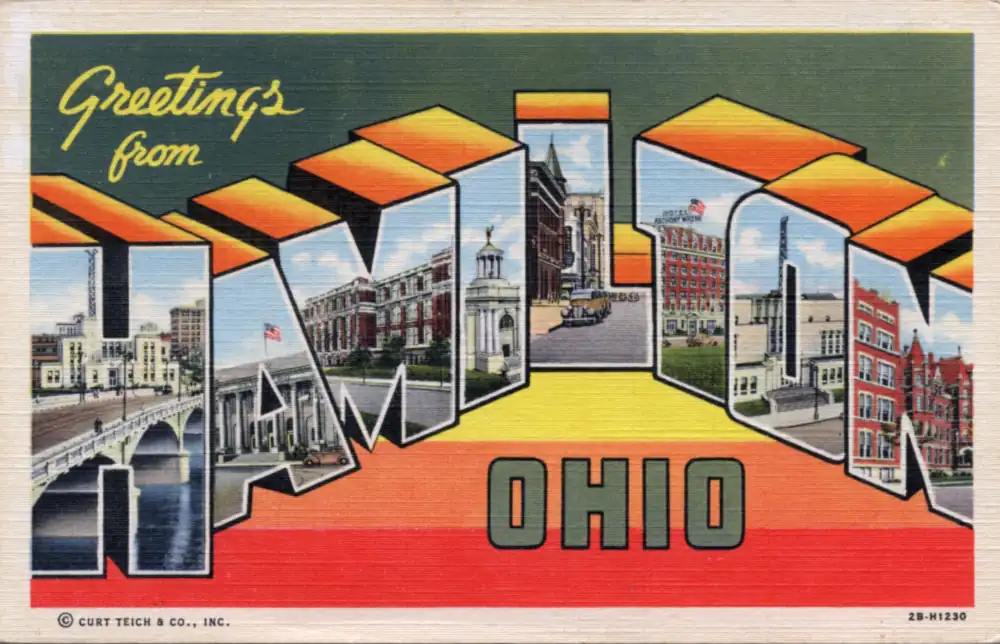
A large-letter souvenir card, printed 1942 by the Wargo News Company of Hamilton.Steve Shook from Moscow, Idaho, USA · CC BY 2.0 -
1914& 1950
Two Hamiltonians who left, and one letter that arrived
Robert McCloskey is born in Hamilton on 15 September 1914; he becomes the first person to win the Caldecott Medal twice, for Make Way for Ducklings and Time of Wonder.
And in May 1950 a manager of the Teikoku Bank in Hiroshima writes to the Mosler Safe Company. His building, 360 meters from the hypocenter, had been reduced to its façade — but the Mosler vaults inside were intact, scorched and rusted and otherwise undamaged. Your products were admired for being stronger than the atomic bomb, he wrote. Mosler advertised on that sentence for a decade.
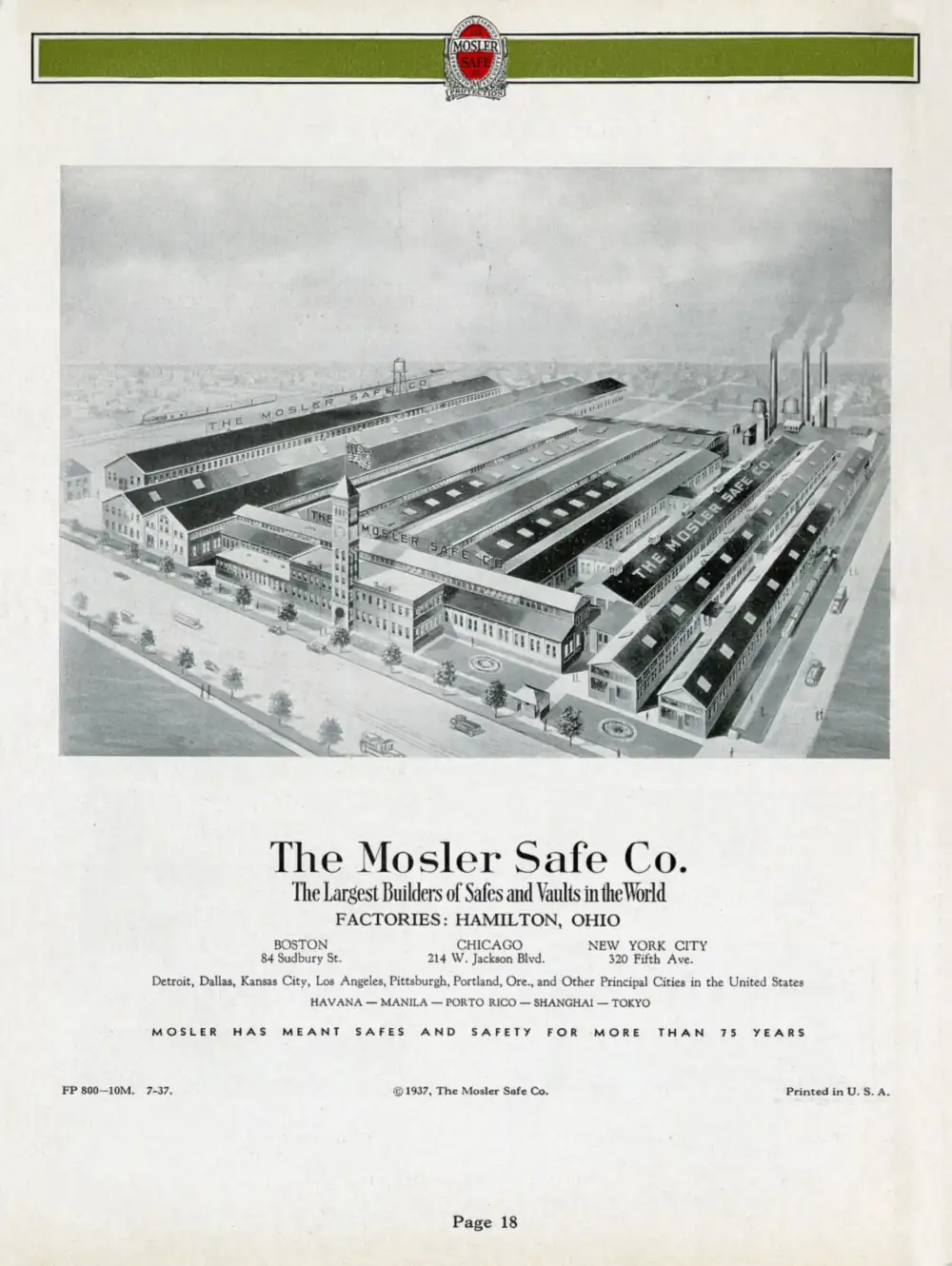
A page from Mosler's catalogue — the engineering the letter was praising.Mosler Safe Company · Public domain 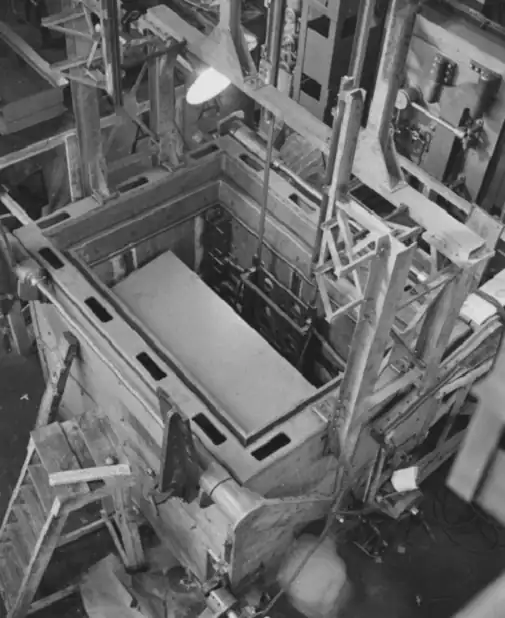
1952: Mosler builds the 50-ton vault that would hold the Declaration, the Constitution and the Bill of Rights. Every night the documents were lowered into it through the floor of the National Archives.The U.S. National Archives · Public domain -
1960
72,345 — the high-water mark
The 1960 census records the largest population in Hamilton's history. Every census since has been smaller. The peak arrives with the factories at full capacity and the interstate system already being drawn somewhere else.
1970 — 1999
The Long Subtraction
The interstates went around, the mills wound down, and the city spent thirty years losing people slowly. It also spent $36,000 on a punctuation mark.
-
197530 Mar
Easter Sunday
On Easter Sunday 1975, eleven members of one family were murdered in a house on Minor Avenue by a relative. It remains among the deadliest killings inside a single American home, and it is the event older residents still measure other bad news against. The details belong to the families, not to a timeline.
-
1970s–1990s
The bypass and the wind-down
The interstate programme of the 1950s routed past Hamilton rather than through it, and the city waits until 1999 for the Butler County Veterans Highway (State Route 129) to give it a direct connection. Meanwhile the great names contract: paper consolidates, machine tool work moves, and Mosler shrinks toward the end.
Population falls from 72,345 in 1960 to 60,690 by 2000 — a slow leak rather than a collapse, which in some ways is harder to organize against.
-
1986
Hamilton!
By a council vote of 5–1, the city officially adds an exclamation point to its name and budgets $36,000 over three years to promote it. The idea came from local marketer Stewart Jones, who got it from Oklahoma!
The U.S. Board on Geographic Names declines to use it. Rand McNally refuses outright. But the mayor ends up on the CBS Morning News, the story runs worldwide, and forty years later people still remember it — which was, arguably, the entire point. Local histories of the city are still published as Hamilton!
A city that could not get a punctuation mark onto a map got onto every front page instead. The 1986 rebranding, in summary
-
1991
Two hundred years
Hamilton marks its bicentennial, counting from the fort. A commission organizes the year; the city is smaller than it was at its centennial celebration's most optimistic projections, and considerably more honest about it.
2000 — present
The Second Current
The recovery runs on the two things the city could not export: the river it was built on, and a few million square feet of extremely well-built industrial floor.
-
2000
City of Sculpture
Ohio's governor designates Hamilton The City of Sculpture. It is a deliberate strategy rather than a slogan: more than forty works are installed through the city, and Pyramid Hill grows into a 470-acre park holding some seventy monumental outdoor sculptures and a museum — an unusual asset for a town this size, and a plausible reason to drive to it.
-
2001
Mosler closes after 134 years
The company whose vaults survived Hiroshima and held the Charters of Freedom files for bankruptcy and shuts its Hamilton headquarters — 110 years after it moved here, and 134 after Gustave Mosler first went into business. The Safe Capital of the World stops making safes.
-
2010& 2015
Best-tasting water in the world
Hamilton's municipal water wins its class at the Berkeley Springs International Water Tasting — repeatedly. The aquifer under the Great Miami, the resource the whole city was founded on, turns out to be a marketable distinction after all.
-
2011–2024
The end of Hamilton paper
Smart Papers announces closure in 2011. Beckett Paper, which began on the Hydraulic in the late 1840s, ceases production in 2012 under Mohawk Fine Papers — more than 160 years of continuous papermaking, finished. In August 2024 a suspicious fire destroys the vacant Beckett building.
-
2014–2017
Turning back to face the river
RiversEdge Amphitheater opens in 2014 and gives away twelve weeks of summer concerts. Marcum Park is completed in 2017. Lofts appear in old commercial blocks; Artspace converts a downtown building for artists. The strategy is consistent: stop treating the Great Miami as the thing that flooded, and start treating it as the front of the city.
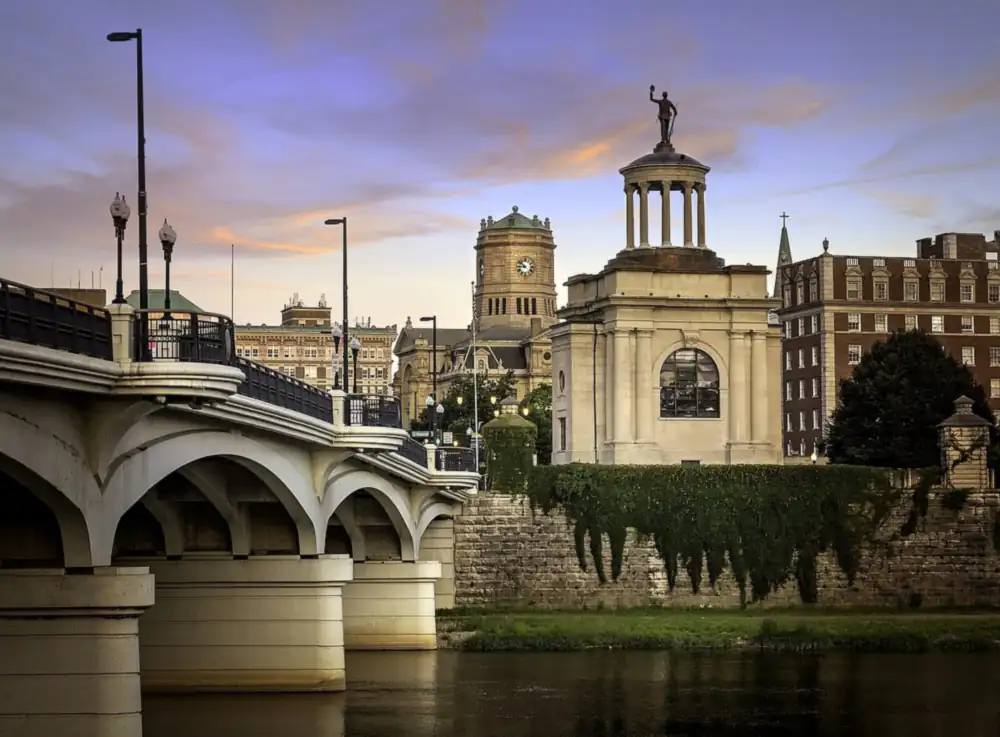
High Street now.McKenzie & Snyder · CC BY-SA 4.0 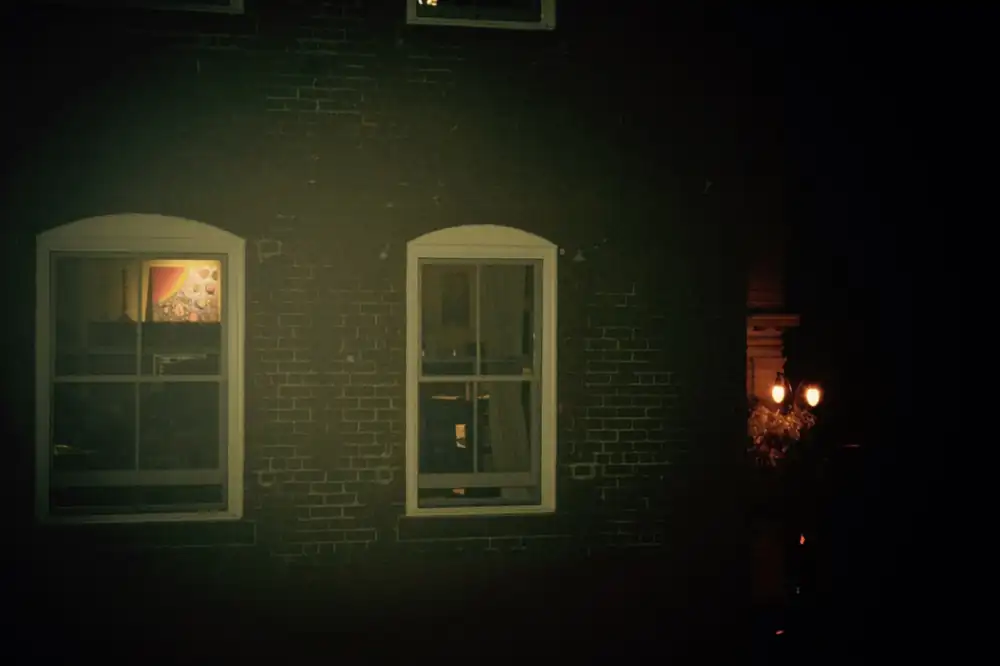
Artspace Hamilton — artists' housing in a repurposed downtown block.Isaac Singleton · CC BY-SA 4.0 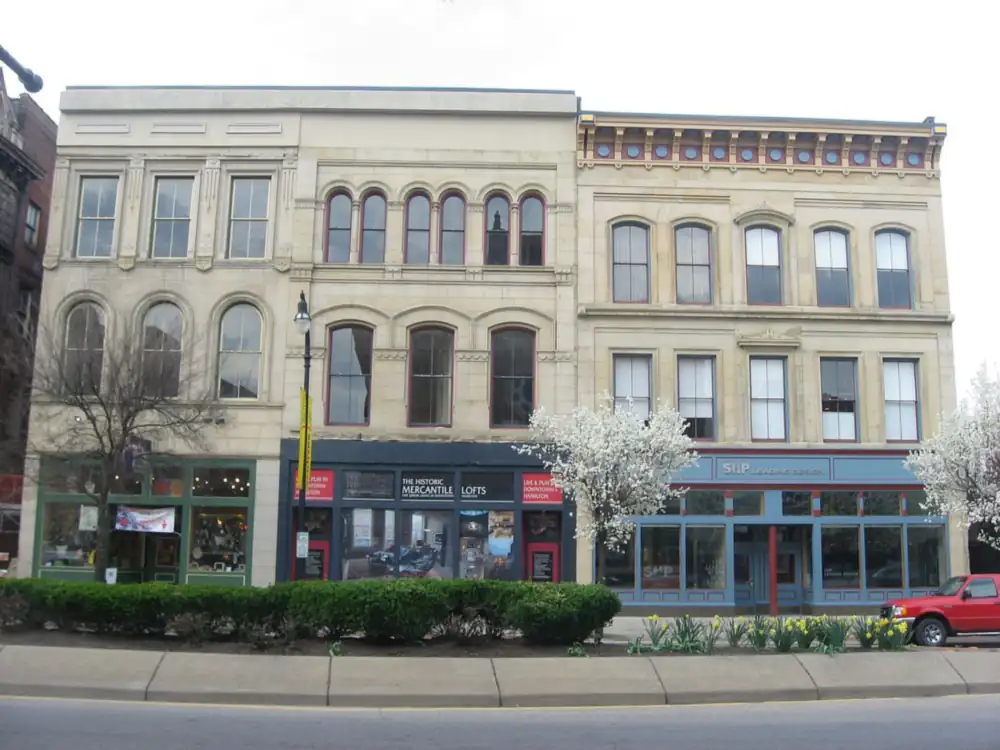
A High Street commercial block, the 1802 grid still holding.Nyttend · Public domain 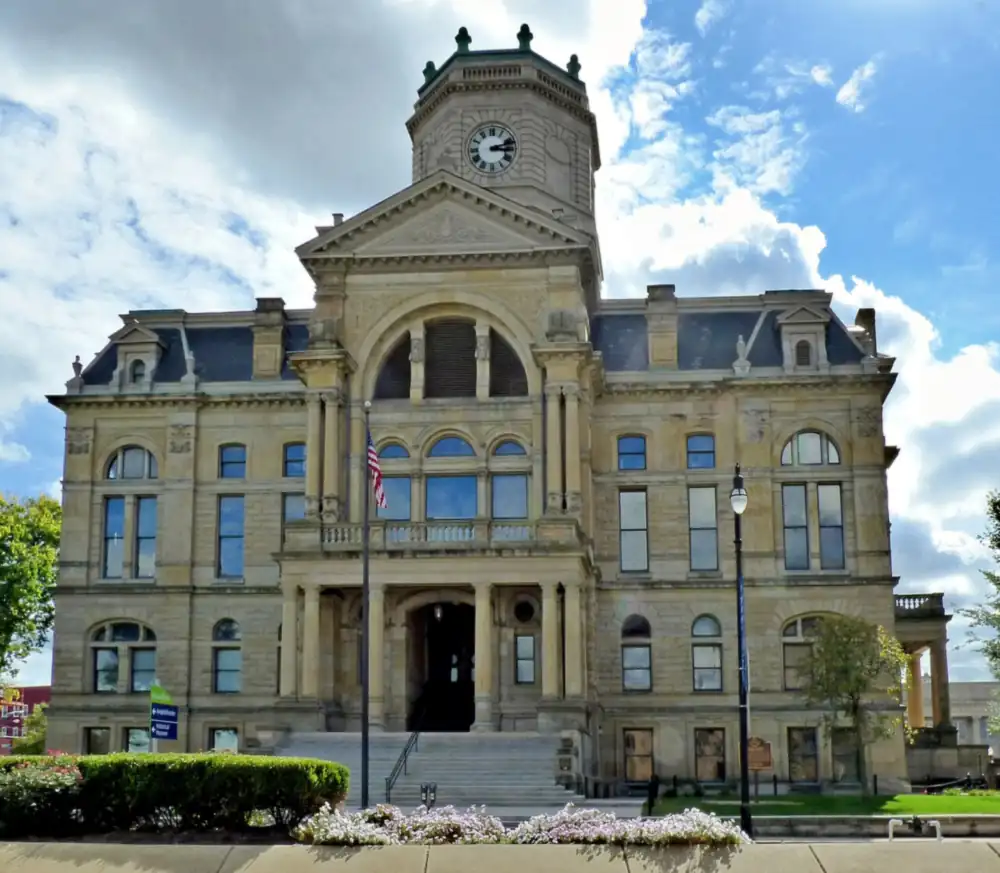
The Butler County Courthouse, north face.Greg Hume · CC BY-SA 4.0 -
2018–2022
The paper mill becomes the largest indoor sports complex in America
Ground breaks in 2018 on Spooky Nook Sports Champion Mill, and it opens in late 2022: 1.2 million square feet of courts, fields and hotel inside the plant that once made the world's coated paper. It is the cleanest illustration of the city's whole method — the buildings were the inheritance, so use the buildings.
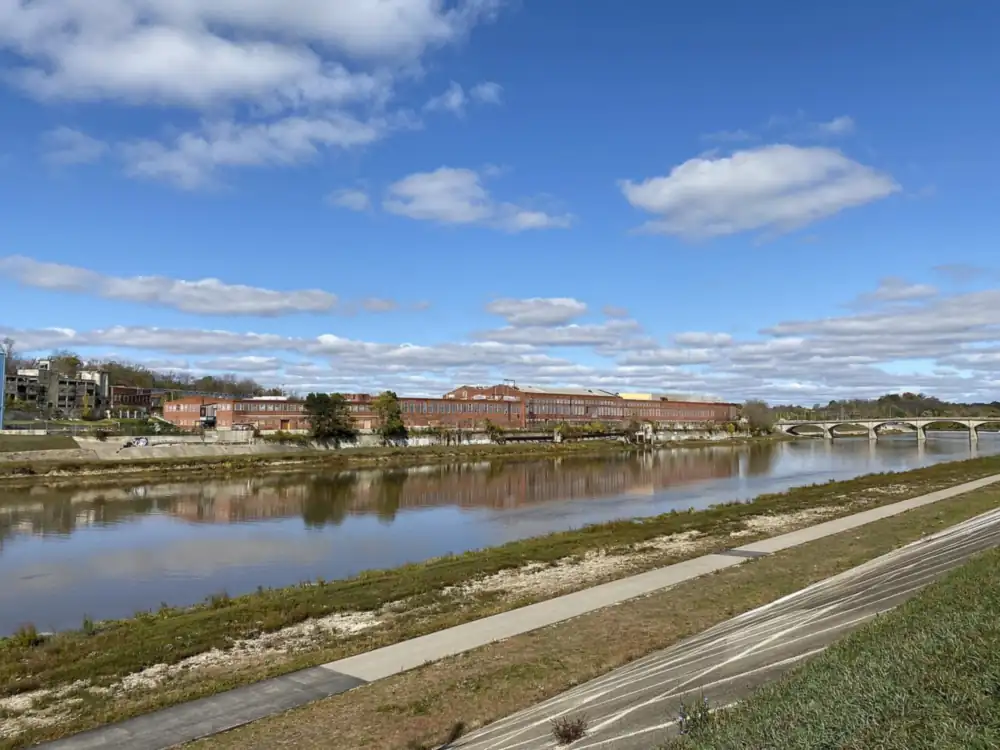
Looking west across the Great Miami to the Champion Mill complex.Smurfetita · CC BY-SA 4.0 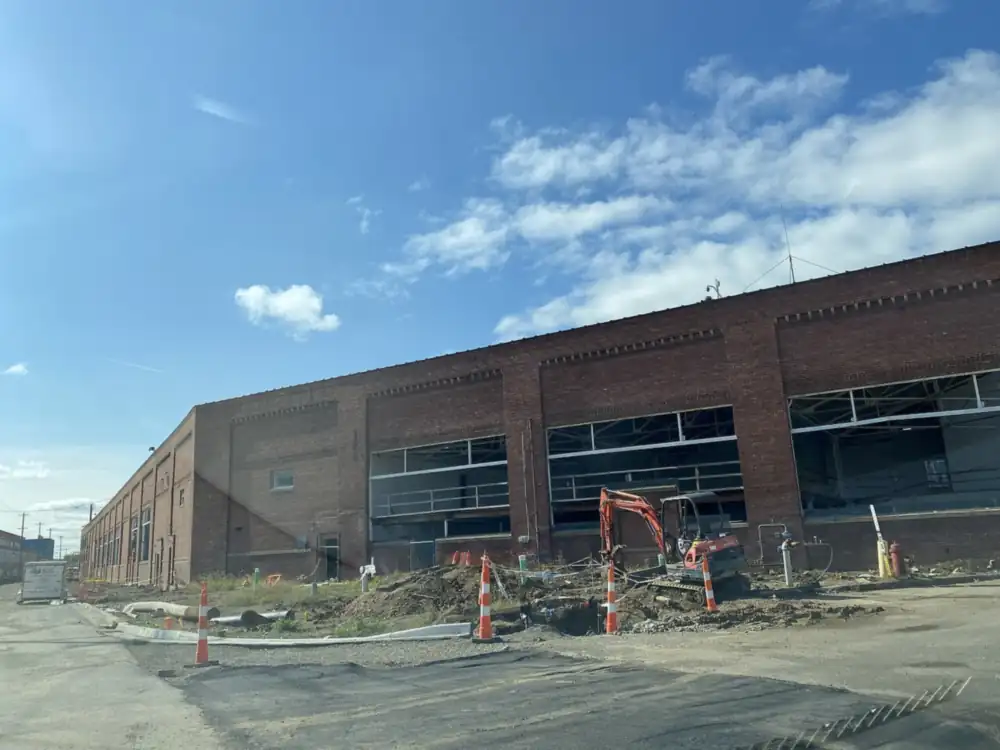
The mill mid-conversion, 2020.Smurfetita · CC BY-SA 4.0 -
2020–today
63,399, and rising again
The 2020 census counts 63,399 people — the third consecutive census to grow, after four that shrank. Hamilton is Ohio's tenth-largest city and the second-most populous in the Cincinnati metro. The 2025 estimate is 64,644.
The bridges are still the center of town. The monument is still at the head of them. The water is still the reason.
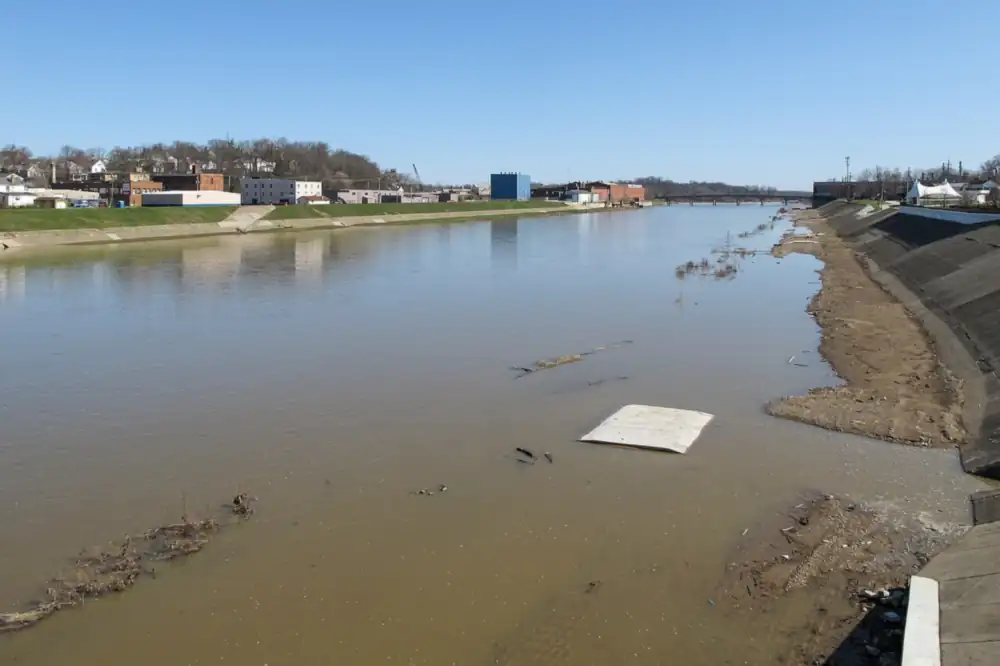
The Great Miami from the High–Main bridge. When this was taken the river stood at 65.85 feet — comfortably below the 73-foot action stage. Somebody is always reading the gauge.Tim Kiser · CC BY-SA 4.0 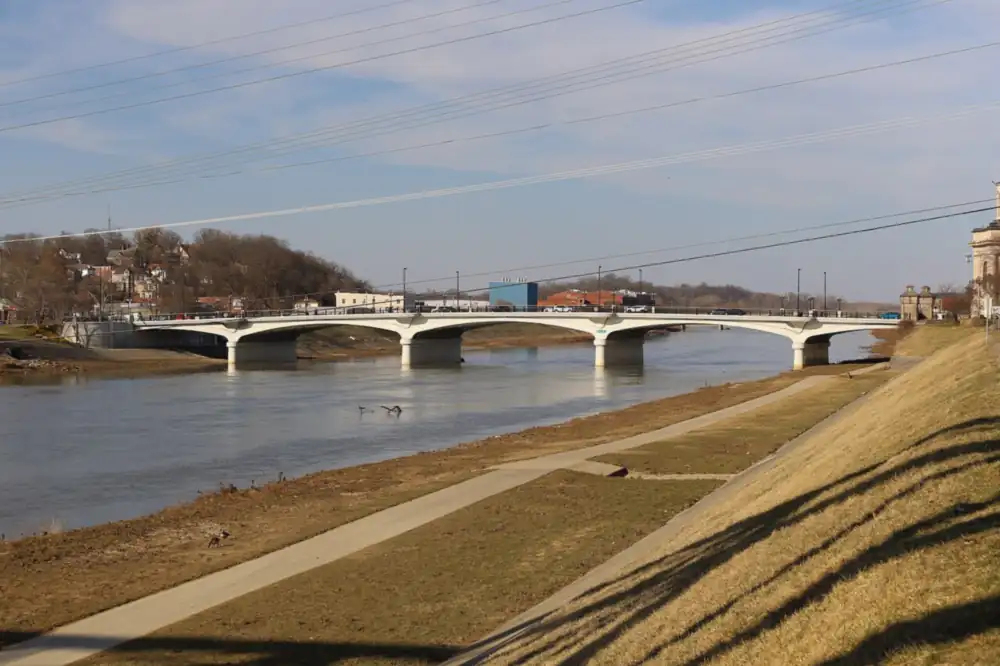
The High Street bridge, 2022 — successor to one of the four lost in 1913.Antony-22 · CC BY-SA 4.0 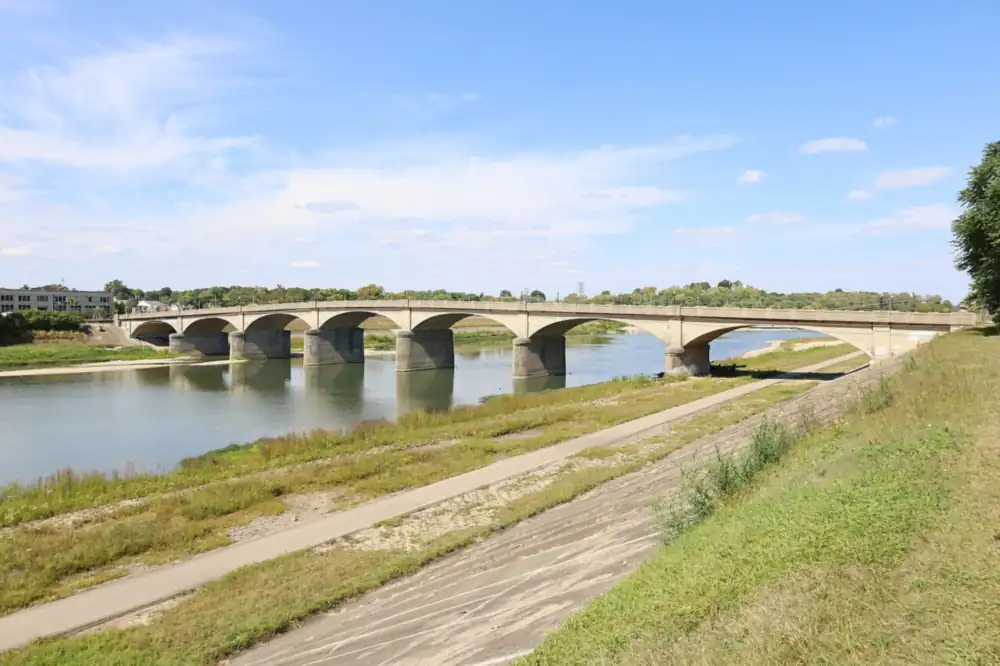
Black Street Bridge, 2023.Antony-22 · CC BY-SA 4.0
Decennial census
Population, 1820 to 2020
Canal and hydraulic growth, an industrial climb to a wartime peak in 1960, forty years of slow subtraction, then a turn back upward after 2000.
Source: U.S. decennial census, as published. The 1930 count (52,176) stands out against 1920 and 1940 and reflects the figures as reported at the time.
| Census | Population | Change |
|---|
Sources
Every date and figure above traces to one of these. Where accounts disagree, the range is noted rather than resolved: the flood death toll is reported variously as “about 100,” “more than 200” and “about 206.”
- History — City of Hamilton, OhioThe city's own account: fort, hydraulic, Rossville merger, flood, revitalisation.
- Hamilton history timeline — Journal-NewsYear-by-year local chronology, from the fort to Spooky Nook.
- Fort Hamilton History — Butler County Historical SocietyConstruction, the 1792–93 additions, dismantling.
- Founding of Fort Hamilton — Historical Marker DatabaseMarker text and dating for the 30 September 1791 completion.
- Hamilton, Ohio — WikipediaCensus series, area and elevation, historic districts, the exclamation point.
- U.S. Census Bureau QuickFacts: Hamilton city, OhioOfficial current population figures.
- The Great Flood of 1913 — Miami Conservancy DistrictRegional toll and the founding of the first watershed flood-control district.
- The 1913 flood in Butler County and Hamilton — Journal-NewsLocal depths, homeless count, and the loss of the four bridges.
- Great Flood of 1913 — WikipediaValley-wide context; “Ohio's greatest weather disaster.”
- Flood & Recovery marker — Historical Marker DatabaseHamilton's own memorial text for 1913.
- Mosler Safe Company — WikipediaFounding, the Hamilton works, and the 1891 move to Hamilton and the 2001 closure after 134 years.
- Protecting the Bill of Rights: the Mosler Vault — U.S. National ArchivesThe 50-ton vault built at Hamilton in 1952 for the founding documents.
- Unbreakable: Hiroshima and the Mosler Safe CompanyThe Teikoku Bank letter of 22 May 1950 and the advertising that followed.
- How a Hamilton company's safe survived an atomic bomb — WCPODistance from the hypocenter and the condition of the vaults.
- Hooven-Owens-Rentschler — WikipediaThe 1845 foundry origin and the Liberty ship engine work.
- Liberty ships — Naval EncyclopediaEngine specification for Ocean Vanguard, built at Hamilton.
- Niles Tool Works — The Walking Tour CompanyRelocation to Hamilton and the scale of its machine tools.
- Ford Tractor plant, Hamilton — Butler County historyThe 1920 opening and the switch from tractors to Model T parts.
- Lane Public Library / Clark Lane marker — HMdbThe 1866 octagon and the claim to the first free library west of the Alleghenies.
- Literary Landmark: Hamilton Lane Library — United for LibrariesFlood damage, the 1914 reopening, and the Robert McCloskey connection.
- Robert McCloskey — WikipediaBorn Hamilton, 15 September 1914; first two-time Caldecott Medalist.
- William Dean Howells — Ohio Reading Road TripThe Hamilton boyhood, 1840–1848, and A Boy's Town.
- Charles Richter — Linda Hall LibraryBorn at Overpeck, Butler County, 26 April 1900.
- Joseph Henry “Hamilton Joe” Nuxhall — Remarkable OhioOhio historical marker for the youngest player in MLB history.
- Hamilton! The exclamation point effort — Journal-NewsThe 5–1 vote, the $36,000, Rand McNally's refusal.
- Hamilton's “Little Chicago” past — Journal-NewsSpeakeasies, casinos, Dillinger's Second Street hideout, police corruption.
- Jim Blount, Little Chicago — Cincinnati & Hamilton County Public LibraryTwo-volume history of the Prohibition era in Butler County.
- Hamilton Avenue was the road to freedom — The Cincinnati HeraldJack and John S. Jones, Charles Cheney, and the Butler County routes.
- Hamilton & Rossville — ArcGIS StoryMapsThe competing hydraulics and the 1854 merger.
- Miami and Erie Canal — Wikipedia274 miles, 1825–1845, Cincinnati to Toledo.
- ZIP Code 45013 — unitedstateszipcodes.orgRossville as the accepted place name for 45013.
- Hamilton, Ohio — BritannicaConcise overview of founding, canal, and industry.
- City of SculptureThe 2000 designation and the public sculpture programme.
- Pyramid Hill Sculpture Park & Museum470 acres and roughly seventy monumental outdoor works.
- “The City of Sculpture” — Greater Ohio Policy CenterAnalysis of Hamilton's downtown revitalisation strategy.
- Postcard Collection — Miami University LibrariesThe source of most period images on this page.
Image credits
All 58 images are in the public domain or openly licensed, and were retrieved from Wikimedia Commons. Each title links to the file's source page, where the full licence and provenance are recorded. Images have been resized and compressed for this page.
- 1844 Diorama Hamilton USA.png
- ArthurStClairOfficialPortrait-restored.jpg
- Artspace Hamilton.jpg
- Bird's-Eye View of Hamilton, Ohio - DPLA - 617a6b45829405f6b3ac336297423e03 (page 1).jpg
- Black Street Bridge (16281528305).jpg
- Black Street Bridge Hamilton 2023a.jpg
- Business District, looking west, Hamilton, Ohio (71570).jpg
- ButlerCountyCourthouseNorthFace02.jpg
- Champion Coated Paper Co. (16095549399).jpg
- City Water Works (15659223644).jpg
- Columbia Bridge (16280698912).jpg
- Corner Ludlow and Second, Looking North, Hamilton, Ohio - DPLA - b1a80b24595c956601aa397054a0d54b (page 1).jpg
- Corner of High and Front Streets (16794078379).jpg
- Court House, Hamilton, Ohio - DPLA - fba3b3cd9433b3335a7a4a36910f8c46 (page 1).jpg
- Crowds Watching Rescuers (20678772182).jpg
- Downtown Hamilton Ohio.jpg
- Great Miami River in Hamilton, Ohio, 2015-04-04-0198.jpg
- Greetings from Hamilton, Ohio - Large Letter Postcard (6279688256).jpg
- Hamilton Champion mill.jpg
- Hamilton Historic Log House 2022.jpg
- Hamilton Steel & Iron Plant (15659158024).jpg
- Herring Hall Marvin Safe Co. (15659165064).jpg
- High Street Bridge Hamilton 2022a.jpg
- High Street Commercial Block in Hamilton.jpg
- High Street Looking West (20067057093).jpg
- Hooven, Owens, Rentschler Co.'s Corliss Engine Works (16094215410).jpg
- Hydraulic Reservoir (20065407544).jpg
- James McBride (pioneer) of Hamilton, Ohio (1892).jpg
- Joe Nuxhall 1957.png
- John Trumbull - Alexander Hamilton - Google Art Project.jpg
- Lane Free Library, Hamilton, Ohio - DPLA - 8043dbcc5d2ab9f05c4da483762bb58b (page 1).jpg
- Long & Allstatter Co. (15661711213).jpg
- Looking West across Great Miami River to Hamilton Champion Mill complex.jpg
- Main Street from A Street looking west, flood at Hamilton, Ohio, March 25, 1913 - DPLA - 72c9989a86dbb3c1e24d58e77d81f19d (page 1).jpg
- Miami Canal or Hydraulic (20678735272).jpg
- Mosler Safe Company 1894.jpg
- Mosler Safe Company Catalog 1932 - Page 18.jpg
- Mosler Safe Works (16279768531).jpg
- Niles Tool Works Co. (16095706817).jpg
- Niles Tool Works, Hamilton, Ohio, 1896.jpg
- Ohio Electric Traction Co. (16279865431).jpg
- Old Clark Lane Mill (15659173034).jpg
- Panoramic View of Paper Mills (16279912541).jpg
- Part of the Champion Co's Plant Destroyed by Fire during Flood March 25, 1913, Hamilton, Ohio - DPLA - e2e372f0bb4eb7d9128fe88ac589edfd (page 1).jpg
- Photograph of Mosler Safe for Constitution, etc. Being Constructed at Hamilton, Ohio (35032484012).jpg
- Pontoon Bridge (16989453791).jpg
- Pontoon Bridge Wrecked (16989462761).jpg
- PostcardHamiltonOHMainStLookingEast1911.jpg
- Powder Magazine (15663955584).jpg
- Replica of a Blockhouse which Formed Part of the Fortifications of Fort Hamilton in Hamilton, Ohio - DPLA - 593054326d7f80e7068425cfc0a945e2 (page 1).jpg
- Shadows on the Miami Canal (16279557351).jpg
- Shuler & Benninghofen Woolen Mills (16281665155).jpg
- Sight of Fort Hamilton (16285595402).jpg
- Soldiers & Sailors Monument (16260508076).jpg
- The four bridges, over Big Miami River and Champion Coated Paper Co., Hamilton, Ohio (71571).jpg
- Trade card for Mosler Safe Company.jpg
- Views of the Hamilton Flood (16285605552).jpg
- William Dean Howells (ca1870).jpg